Skip to content

GCL Pond Lining · West Midlands

GCL pond lining in Coventry

Coventry's green edges, from the country parks on its eastern side to the brooks feeding the Sowe and the Sherbourne, are where a natural-bed pond makes most sense. A geosynthetic clay liner gives that finish, and we install GCLs across the city when the site suits one.

Where we install
  • Binley
  • Willenhall
  • Walsgrave
  • Wyken
  • Allesley
  • Coundon
  • Brandon
  • Ryton-on-Dunsmore

Base · Tamworth B78 2BP

Where a clay liner earns its place

Inside a GCL is a thin bed of sodium bentonite, stitched between two fabrics. Buried under soil and soaked, that clay expands until water barely passes through it, and it keeps that ability: a small hole made later by a root or a sharp stone is closed by clay pushing into it. For a wildlife pond on the edge of a nature area or a planted SuDS feature on a new Coventry estate, that soft, soil-covered bed is often exactly what the ecologist wants.

It is not the answer for every pond. GCLs need confinement under soil or water, prefer gentle bank slopes, and must suit the water that will sit on them. If a design has steep sides, exposed edges or aggressive contents, a welded membrane is the better choice, and we would say so.
Checking the site first

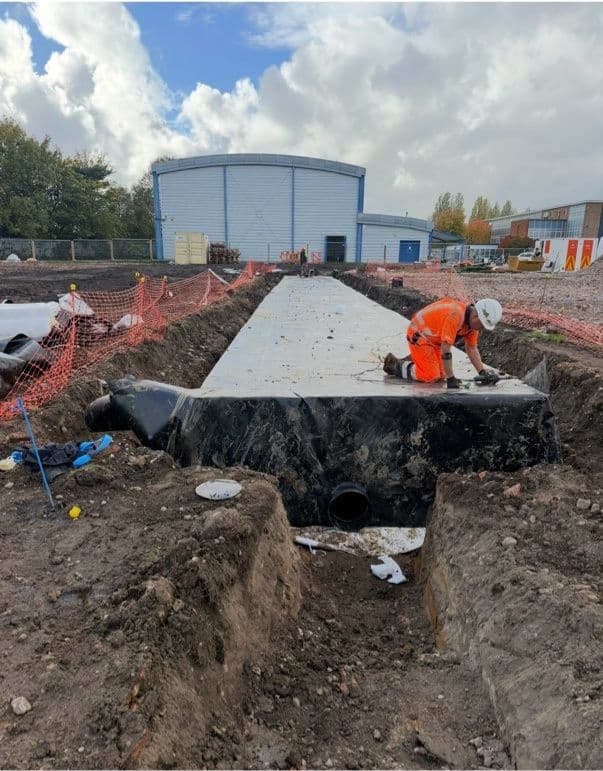
Before we recommend a clay liner we look at the profile, the cover the design allows for and the source of the water. Runoff from roads and roofs, a brook, or groundwater each behaves differently against bentonite, and the suitability check is there so nobody finds out after handover.

Then the formation. Your groundworker trims and compacts it; we inspect it for sharp stones, ruts and soft patches and give it our sign-off before any roll is unwound. Whatever is under a clay liner shows through in how well it works.

Laying, lapping and detailing

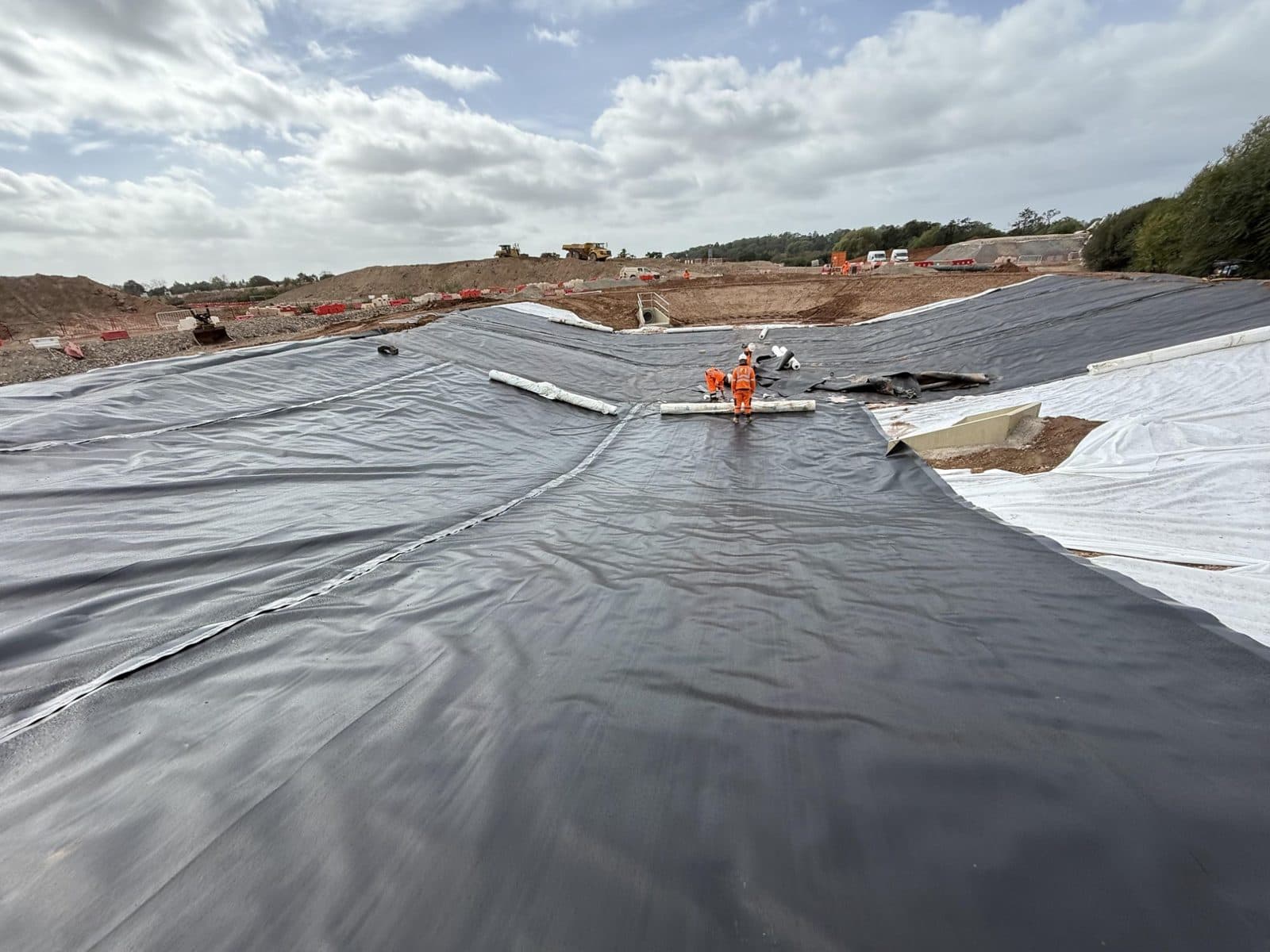
The rolls overlap by a wide margin, and each lap is dressed with bentonite, as paste or loose granules, before the next roll covers it. Nothing on a GCL is welded: the joint closes because the clay in the overlap swells. Inlet pipes, outlet structures and the top of the bank each take their own collar of paste, and our records list each lap and detail as it is finished.

On a park pond with a timber dipping platform or a stone headwall, those fixed structures take most of the time. A neat paste collar at each one is what keeps the water level steady in the years after.

  • Suitability check on profile, cover and water chemistry
  • Formation inspected and signed off before laying
  • Laps closed with paste or granules
  • Every pipe, headwall and edge given its own detail
  • QA records stating the cover depth required

Cover follows straight after

After handover, the soil goes on to the depth our records state, and only then is water let in. That order matters. Bentonite that meets rain while it is still uncovered swells in the wrong places and loses its seal, so on Coventry jobs we agree the covering programme before laying starts and unroll only as much as can be buried that day or the next.

GCL Pond Lining Coventry

Frequently asked questions

Often. The finished bed behaves like a traditional clay-puddled pond and supports planting. We check the slopes, cover and water source first to confirm it suits the site.

Only if the liner stays dry until then. Rain on an uncovered GCL starts the swelling, so we plan the laying to match how fast your contractor can cover it.

We lay GCLs made by NAUE, CETCO and Solmax, plus the UK makers Geosyn and Wrekin, using whichever the specification names or recommending one if it leaves the choice open.

Tell us about your project

Quote back within one working day