Skip to content

Soakaway Tanks · West Midlands

Soakaway installation in Coventry

Coventry's ground changes from street to street: red sandstone and mudstone at depth, glacial clay over much of it, and pockets of sand and gravel towards Baginton and the Avon valley. Where the percolation results say the water will go, we supply and install crate soakaways, or install only.

Where we install
  • Earlsdon
  • Stoke
  • Foleshill
  • Allesley
  • Eastern Green
  • Baginton
  • Willenhall
  • Wyken
  • Finham
  • Styvechale

Base · Tamworth B78 2BP

Which Coventry plots can take the water

On the clay that blankets large parts of the city, an infiltration test often fills the trial pit and leaves it full the next morning. On the sands and gravels along the Avon and the lower Sowe, results tend to be much better, and a soakaway becomes the simplest way to deal with roof and yard water.

We don't guess which kind of plot you have. Your engineer arranges the testing and sizes the structure from the results, and we build what the drawing shows. If the numbers look marginal for the volume drawn, we raise it before the crates are ordered rather than after they are buried.
Fitting a soakaway onto a city plot

Much of the soakaway work in Coventry is small: a rear extension in Earlsdon, a pair of infill houses in Stoke, a new unit on an older industrial estate in Foleshill. On plots like these the tight part is rarely the volume. It is finding a spot far enough from foundations and boundaries, which Approved Document H sets out, with a route for the inlet pipe that misses existing drains.

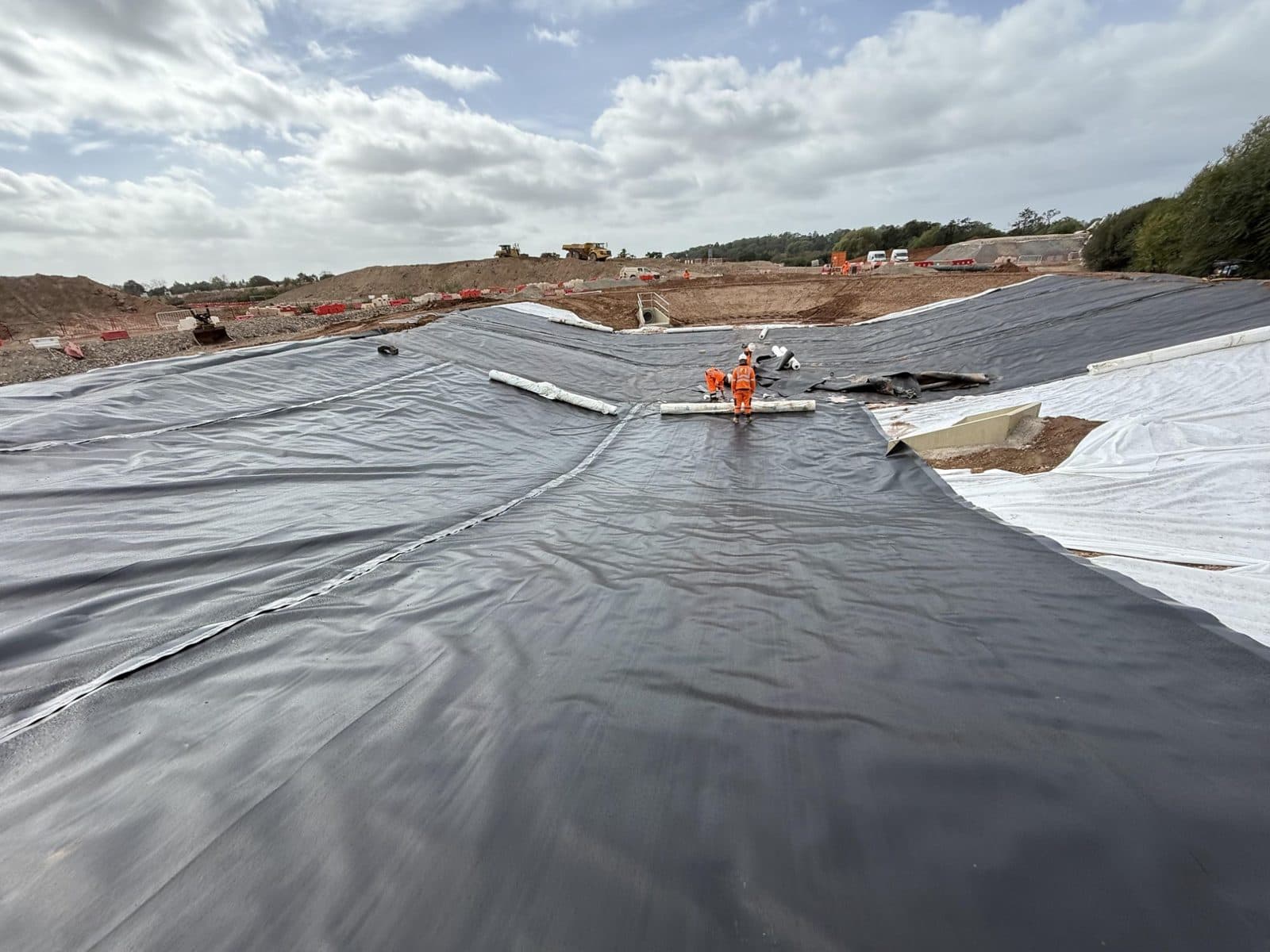
Larger housing schemes on the city's western and northern edges have more room, and the crates there often sit under public open space or a rear garden strip. Either way, crates build to the hole the engineer has drawn, so a long, narrow trench along a boundary is as easy for us as a square pit.

Building it in the pit

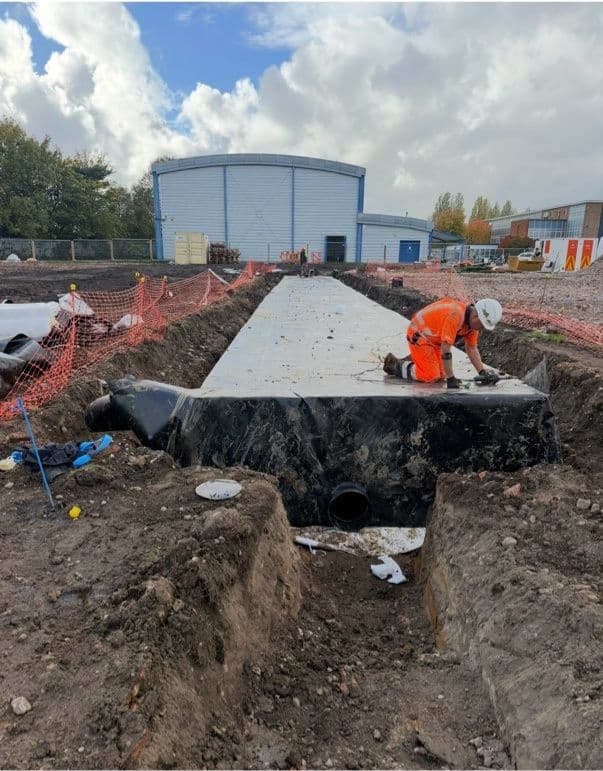
The excavation belongs to your groundworker. Once it is formed to level, we walk the base, check it for soft spots and lumps of brick or clay, and only then start. A permeable geotextile goes in first, lapped up the sides. The crates are stacked within that lining, row by row, until the volume on the drawing is reached, and the inlet pipe and catchpit are connected where the engineer has placed them.

A soakaway never gets a membrane, since the aim is for water to pass out through the wrap while silt and fines stay outside it. We fold the geotextile over the top layer, record the inspection, and leave the structure ready for your backfill.

  • Geotextile wrap and crates supplied to the drawing, or fitted from your stock
  • Catchpit and filter connections made as the design shows
  • Wrap folded over and inspected before backfill
  • Records ready for building control

Keeping silt out of it

A soakaway that silts up stops draining, and on a Coventry building site there is plenty of clay in the runoff during construction. The catchpit upstream is what protects the crates. We connect it to the design and point out on handover that it needs emptying, especially in the first months while the site is still being finished.

Soakaway Installation Coventry

Frequently asked questions

Yes, but not with a soakaway. If the ground won't take the water, your engineer will usually move to a sealed attenuation tank with a controlled outlet, and we install those too.

If the test passes and there is room for the clearances, often yes. A small crate soakaway is quick to build once the pit is dug, and we install them at that scale as readily as on an estate.

Your engineer or designer organises it, not us. We build from their results and their drawing.

Yes, if the design specifies crates for vehicle loading. Tell us what will be on top and we build to the loading class on the drawing.

Tell us about your project

Quote back within one working day