The East of England is flat, but its ground is anything but uniform. The Fens of north Cambridgeshire and west Norfolk are peat and silt at or near sea level, kept dry by pumped drainage and managed by Internal Drainage Boards. Chalk runs in a band from the Chilterns in Hertfordshire and Bedfordshire, south of Cambridge and up under Norfolk. Boulder clay caps much of Suffolk and Norfolk, gault clay runs through Cambridgeshire and Bedfordshire, and London Clay underlies much of Essex.
The Great Ouse, the Nene and the Cam drain the west of the region to the Wash. The Yare, the Waveney, the Stour, the Colne and the Chelmer run east to the North Sea, and the Lea takes Hertfordshire south towards the Thames.
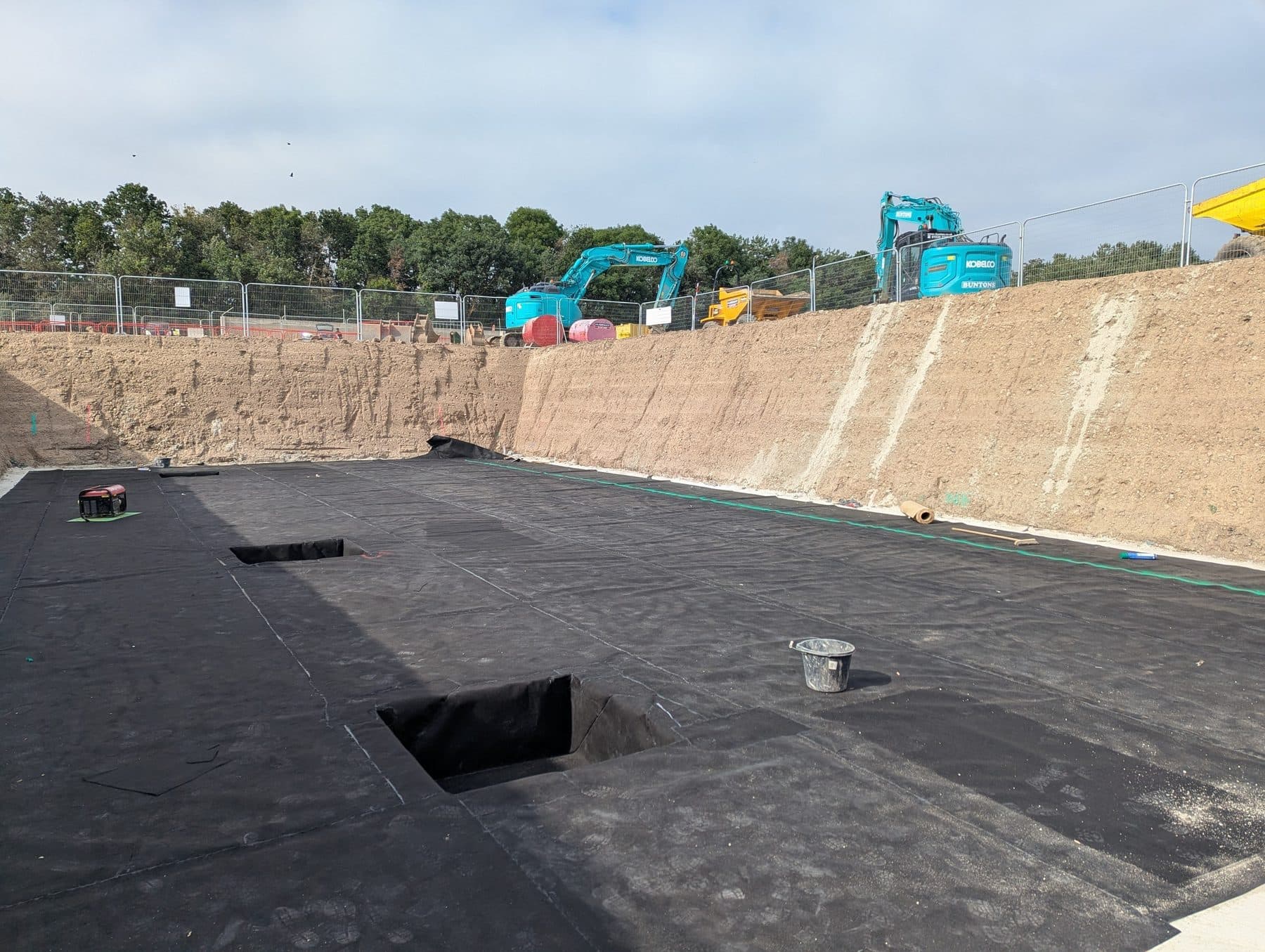
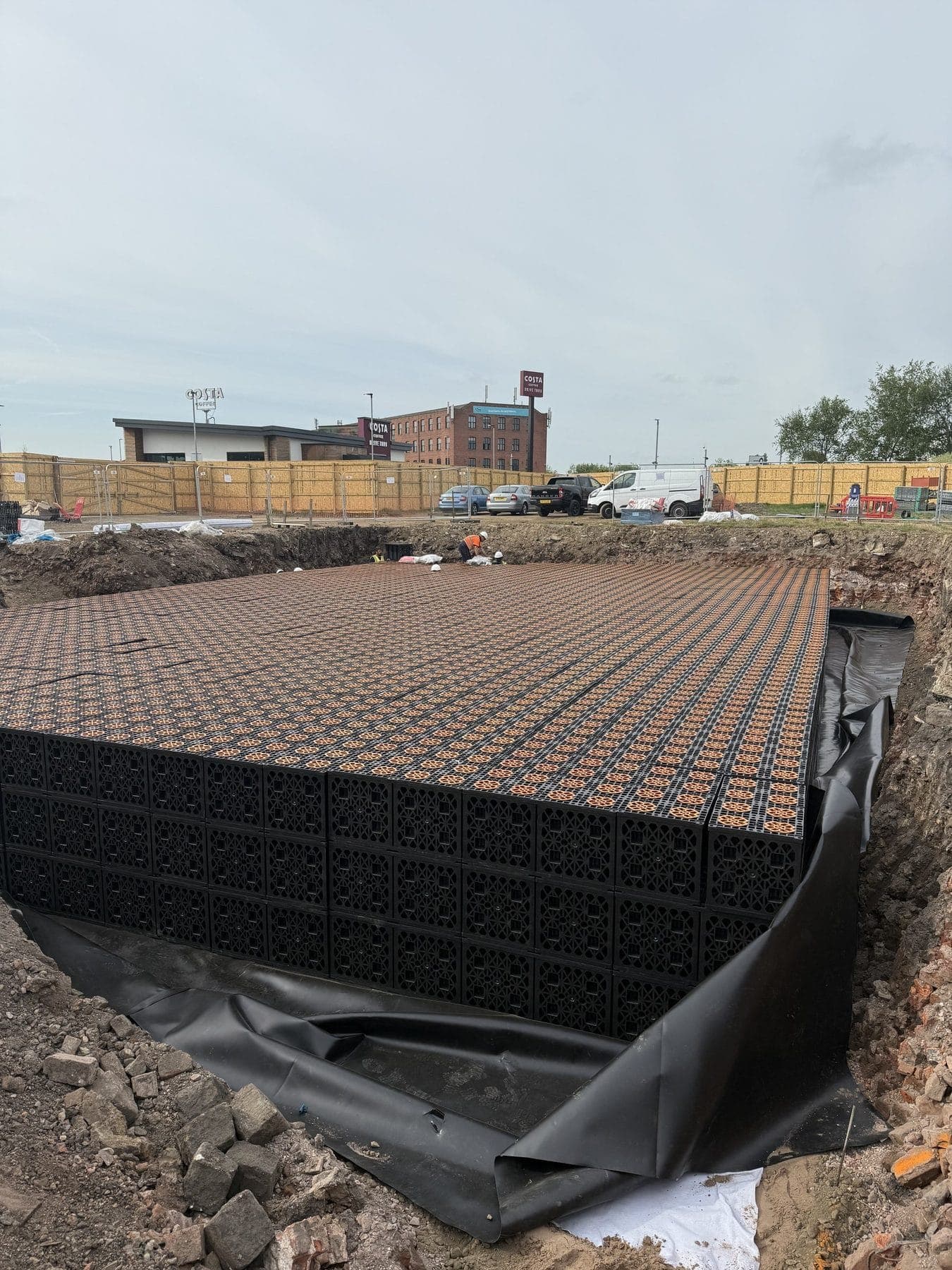
Where there's chalk, sand or gravel with groundwater well below the base, a soakaway can work, although the chalk also supplies drinking water and some sites are restricted for that reason. On the fens and the clays, with slow infiltration or high groundwater, surface water is stored and released slowly. Across much of the region that means a sealed attenuation tank.
Housing and science-park growth around Cambridge and Peterborough, new settlements across the region, and commercial schemes along the A14, the A1(M) and the M11 all need storage under roads, car parks and yards. Long, narrow tanks are common where the layout leaves only a strip beside a road or boundary.
Much of East Anglia is arable farmland. Irrigation reservoirs, farm ponds and lined lagoons are a big part of the lining work here, and each one needs welded seams and a liner that suits what it holds.
The East of England is part of our UK-wide coverage from our Tamworth base. The A14 brings us across to Cambridgeshire and on to Suffolk, and our crews travel with their own welding kit.
Approvals stay with the developer and their engineer: the lead local flood authority at planning, the Internal Drainage Board where a site discharges into its watercourses, and the sewerage company for a sewer connection. We build to the approved design and hand over the weld test record and QA pack those bodies ask to see.
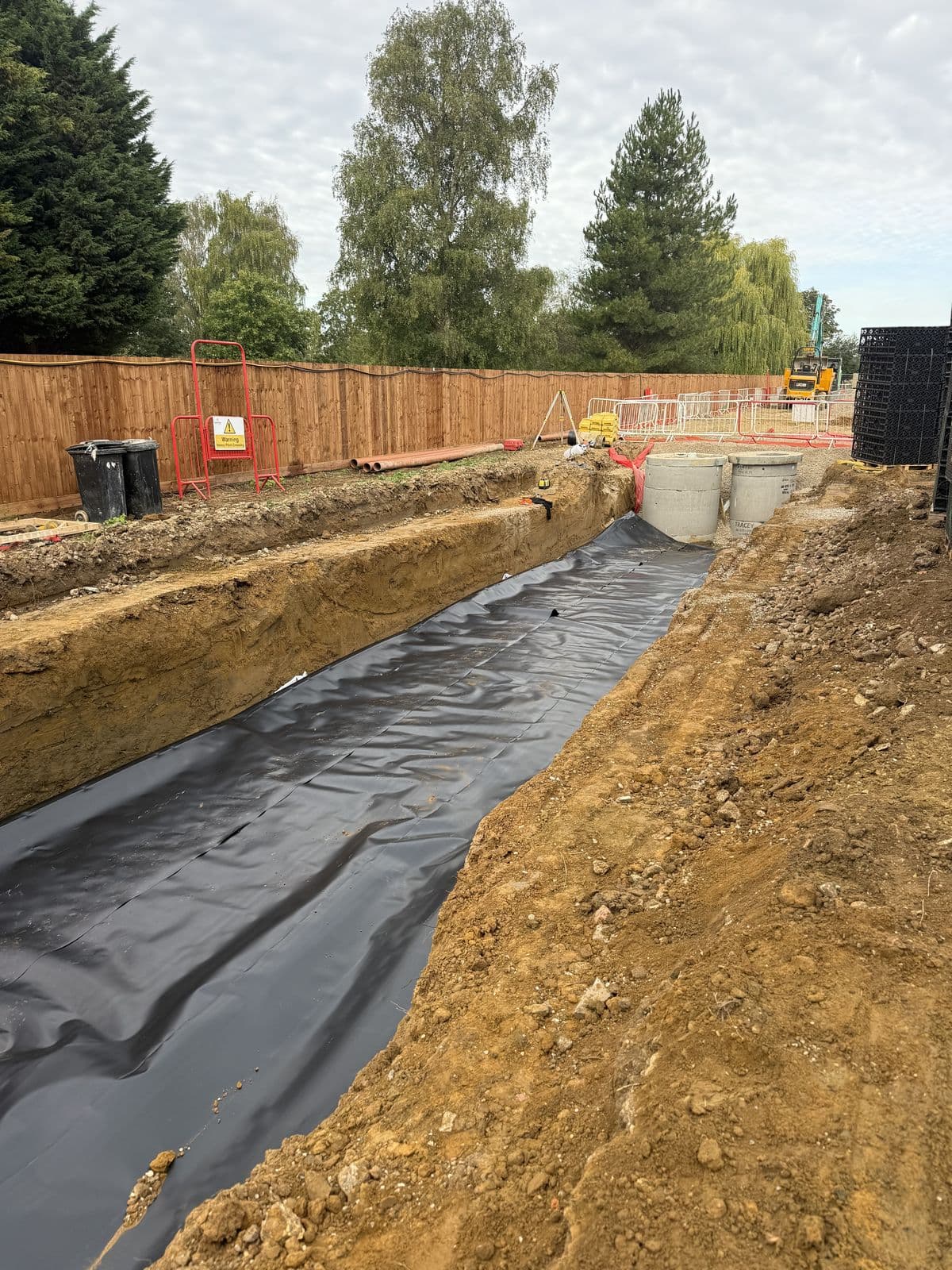
At Cottenham, on the fen edge north of Cambridge, we built a 51.5m linear attenuation tank only 2m wide and 0.8m deep, about 82m³ of storage in a trench beside a new development. The LLDPE membrane ran the full length, with the fittings and vent detailed by hand so the wrap stayed continuous end to end.