Skip to content

GCL Pond Lining · West Midlands

GCL pond lining in Solihull

For a pond that should look as though it has always been part of the Arden landscape, a geosynthetic clay liner is often the right material. It leaves a natural clay bed under the soil, which suits the wildlife ponds on Solihull's newer estates, and we say plainly when a pond would be better in membrane.

Where we install
  • Dickens Heath
  • Cheswick Green
  • Tidbury Green
  • Hockley Heath
  • Knowle
  • Berkswell
  • Hampton-in-Arden
  • Olton

Base · Tamworth B78 2BP

A clay liner in clay country

Arden farmland is dotted with old field ponds, many of them dug for marl or for watering stock, and their beds are clay. A GCL builds a new pond on the same principle. A layer of sodium bentonite is stitched between two geotextile carriers, and once it is wetted under cover it swells into a barrier that water can barely get through.

For a wildlife pond on a housing scheme in Dickens Heath or Cheswick Green, that matters. Plants root into the soil cover, invertebrates find a muddy bed, and the pond looks like it has always been there. If a root or a stray fork goes through, the hydrated clay swells into the hole.
Is your pond suited to a GCL?

A GCL has to be confined. It needs a soil layer on top to swell against, and it suits gentle bank profiles that hold that cover in place. Steep sides, exposed edges and ponds that are drained right down every summer generally point to a membrane instead.

Water chemistry counts too. Bentonite seals best in ordinary fresh water, and some feeds, such as runoff from certain industrial yards or very hard groundwater, can reduce how well it swells. We look at the source before recommending a clay liner.

  • Gentle side slopes that hold a soil cover
  • Permanent water or a cover deep enough for the product
  • Ordinary fresh water feeding the pond
  • A formation free of stones and roots

Estate ponds and balancing basins side by side

Newer housing in the south of the borough often has a wildlife pond in its landscaping as well as a basin for storm water. The wildlife pond usually has shallow, shelving margins for planting, which is exactly the profile a GCL likes. The balancing basin, which fills and empties with every storm, may be specified in a welded membrane instead. We can lay both in one visit, so the landscape contractor deals with one lining team.

Laying and detailing

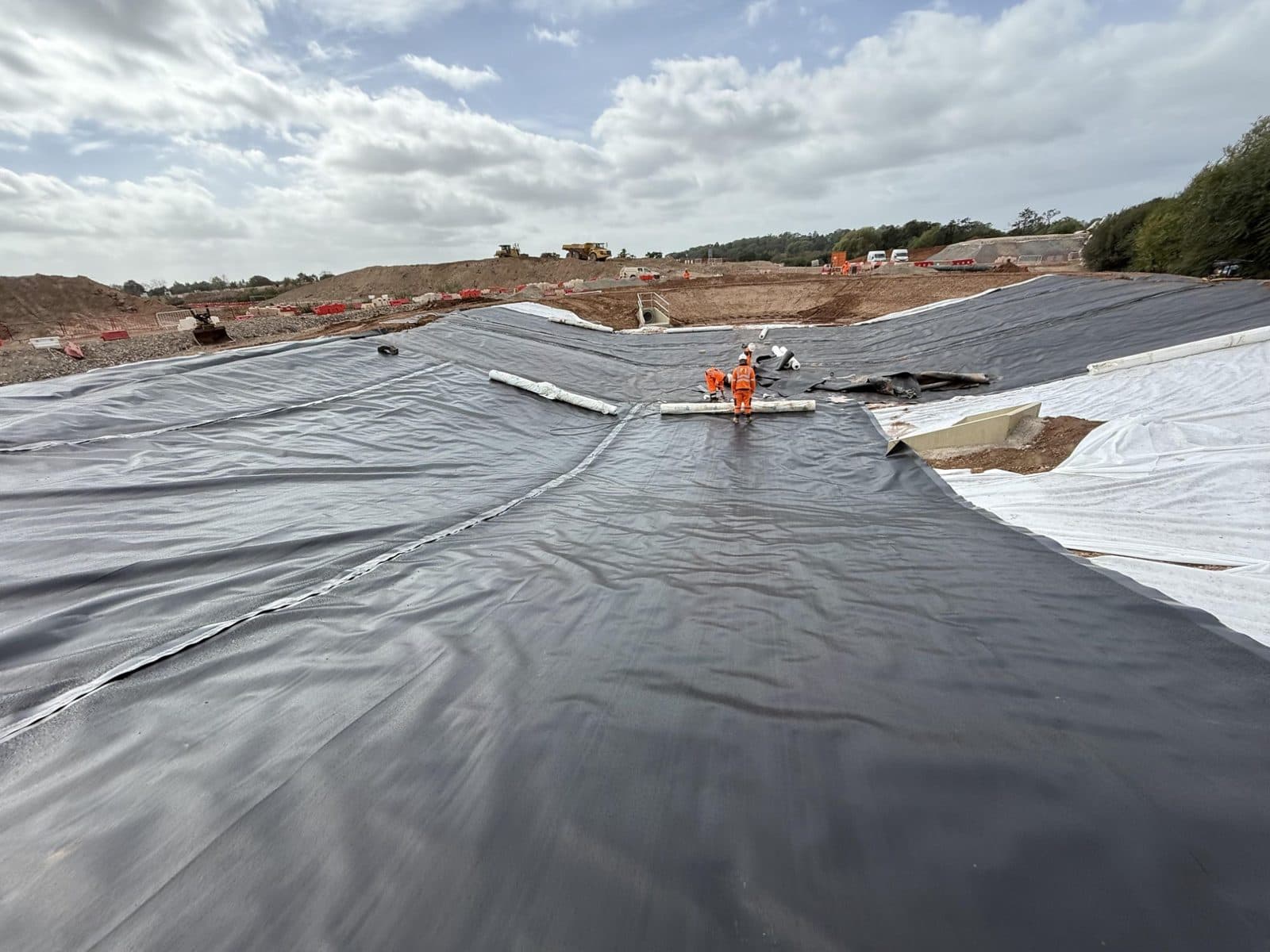
Your groundworker forms the pond and trims it smooth. We walk that surface and approve it before any GCL is unrolled, since the clay can't make up for stones or ruts beneath it. Rolls are run out with generous laps between them, and bentonite paste or granules goes into every lap. Inlets, outlet pipes and any headwall are detailed with bentonite paste, and every lap and detail goes on the record as we work.

Cover follows straight after

At handover you get the lap and detail records, along with the cover depth this product needs. Your contractor then places the soil and lets the pond fill. That step should not wait: bentonite wetted before its cover is on swells freely and loses its sealing power, so we agree the sequence with the groundworker before we start.

GCL Pond Lining Solihull

Frequently asked questions

Plants and wildlife take quickly to the soil-covered clay bed, and small punctures close up on their own. Steep or exposed banks are better served by a welded membrane.

Your own contractor, and it should follow on directly. We state the depth required and agree the order of work so the liner never sits wet without its cover.

NAUE Bentofix, CETCO Bentomat, Solmax and the UK-made rolls from Geosyn and Wrekin. Name one in your specification and we lay it; leave it open and we will suggest one for the pond.

Tell us about your project

Quote back within one working day