
Skip to content

GCL Pond Lining · Yorkshire

GCL pond lining in Sheffield

Around Sheffield, a clay-lined pond suits wildlife schemes and landscaped basins on the gentler ground at the city's edge. We lay geosynthetic clay liners with every overlap sealed in bentonite and a running record of the work.

Where we install
  • Handsworth
  • Woodhouse
  • Mosborough
  • Halfway
  • Hillsborough
  • Wadsley
  • Stocksbridge
  • Chapeltown
  • Rotherham

Base · Tamworth B78 2BP

Clay-bed ponds around the city edge

Most GCL enquiries here come from new housing on the fringes, nature areas along the river corridors and estates that want a pond which will green over and look as if it has always been there. A GCL ends up buried under soil, so plants root into a real bed and nothing shiny shows at the waterline.

SuDS basins are the other common use. On a housing scheme where part of the basin holds water all year for amenity and wildlife, a GCL in that permanent pool gives a bed the margins can colonise, with the inlet and outlet structures detailed in bentonite where they pass through it. The engineer fixes the volume and levels; we line what has been shaped.

Inside the GCL is a layer of sodium bentonite, carried by two geotextiles. Once wet and held down, it swells into a very tight barrier, and should something sharp pierce it later, the swollen clay moves in to close the gap.
Does the site suit a clay liner?

Not every Sheffield pond does, and we would rather say so at the start. A GCL needs confinement and a profile gentle enough to keep its cover soil in place, so a basin cut steeply into a valley side may be better served by membrane. Your designer sets the slopes; we tell you if they are beyond what a clay liner should be asked to do.

Water source matters too. Bentonite is sensitive to some water chemistry, and a pond fed by peaty moorland streams is not the same as one topped up from the mains. We ask where the water comes from before recommending a product.

Panels, laps and the awkward bits

The groundworker shapes and compacts the formation. On Coal Measures ground that can take a second pass, because broken sandstone keeps surfacing. We sign the bed off once nothing angular is standing proud of it.

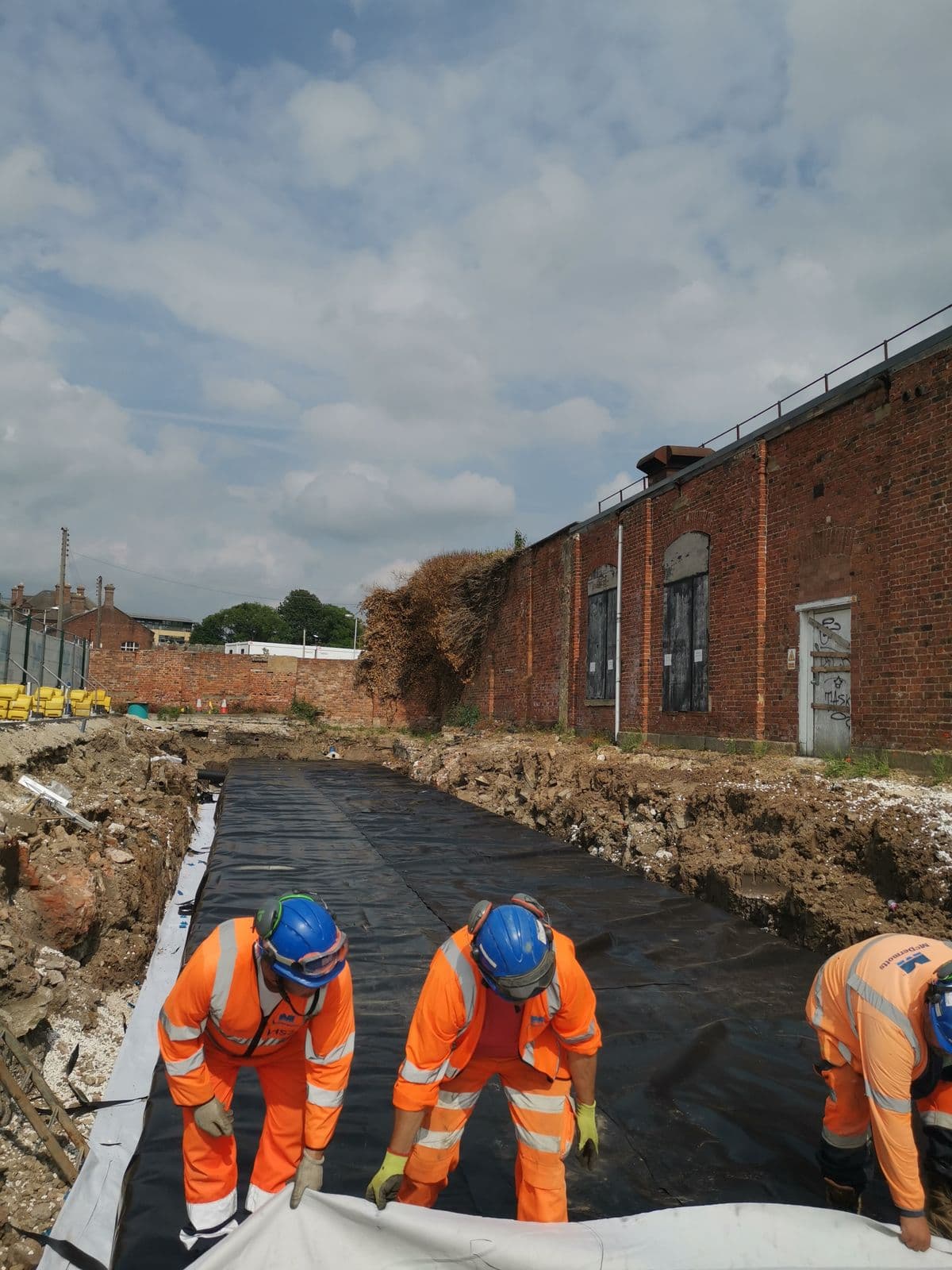
  • Rolls run out with generous overlaps between panels
  • Each overlap dressed with bentonite paste or loose granules
  • Pipes, edges and headwalls detailed with the same bentonite
  • Each lap and detail logged as the work goes

Cover goes on straight after us

At handover you get the QA record plus the depth of soil this particular liner calls for. Your contractor places that soil and hydrates the GCL, and timing matters: bentonite that takes on water with nothing pressing down on it expands freely, loses its seal and is spoiled. On a showery Sheffield day that means booking the cover crew to follow close behind us.

Once covered and wet, the pond can be planted and filled. Over a season or two the margins grow in, and on a wildlife scheme the result is hard to tell from an old clay-puddled pond.

GCL Pond Lining Sheffield

Frequently asked questions

It is often the better fit on shallow-sided basins that end up under soil, because it gives a natural bed. Where the banks are steep or the edge will be exposed, membrane is usually the safer choice.

Your contractor, as soon as we hand over. We tell you how deep that soil must be and leave the lap records with you.

No. A clay liner is jointed by overlapping the panels and sealing each lap with bentonite paste or granules, not by welding.

Small punctures from roots are where bentonite earns its keep, because the hydrated clay swells into them. It is no excuse for running plant over the liner, though, and big trees right on the bank are worth raising with your designer.

Tell us about your project

Quote back within one working day