
Skip to content

GCL Pond Lining · Yorkshire

GCL pond lining in Bradford

In wooded valleys and conservation settings around Bradford, a pond that looks natural from the first season is often the brief. A geosynthetic clay liner gives that, with a bentonite core that seals small punctures, and we install it with every overlap sealed and recorded.

Where we install
  • Saltaire
  • Shipley
  • Baildon
  • Bingley
  • Cottingley
  • Ilkley
  • Burley-in-Wharfedale
  • Menston
  • Steeton

Base · Tamworth B78 2BP

Natural-looking water in a sensitive setting

Around Saltaire, Shipley Glen, the Wharfe valley and the edges of the moors, landscape and heritage weigh heavily in what gets approved. A GCL sits under a layer of soil, so the pond bed is earth that plants can root into, and there is no membrane edge to show at the water line.

Trees grow close to water in these valleys. If a root works through the liner, wet bentonite swells into the gap, which is one reason the material suits wooded sites.
Checking a clay liner will work

Bentonite needs to be held down by cover soil or water to form a tight barrier, and it needs banks gentle enough to keep that cover in place. Where the plan shows steep sides or exposed edges, membrane may be the better product, and we will say so.

We also ask how the pond will be fed. Peat-stained water off the moors, spring water and mains top-up behave differently, and water chemistry is part of whether a GCL is right.

If the answer is no, we will point you to a welded membrane instead. We install both, so there is no reason to push a clay liner where it doesn't belong.

Laying the panels

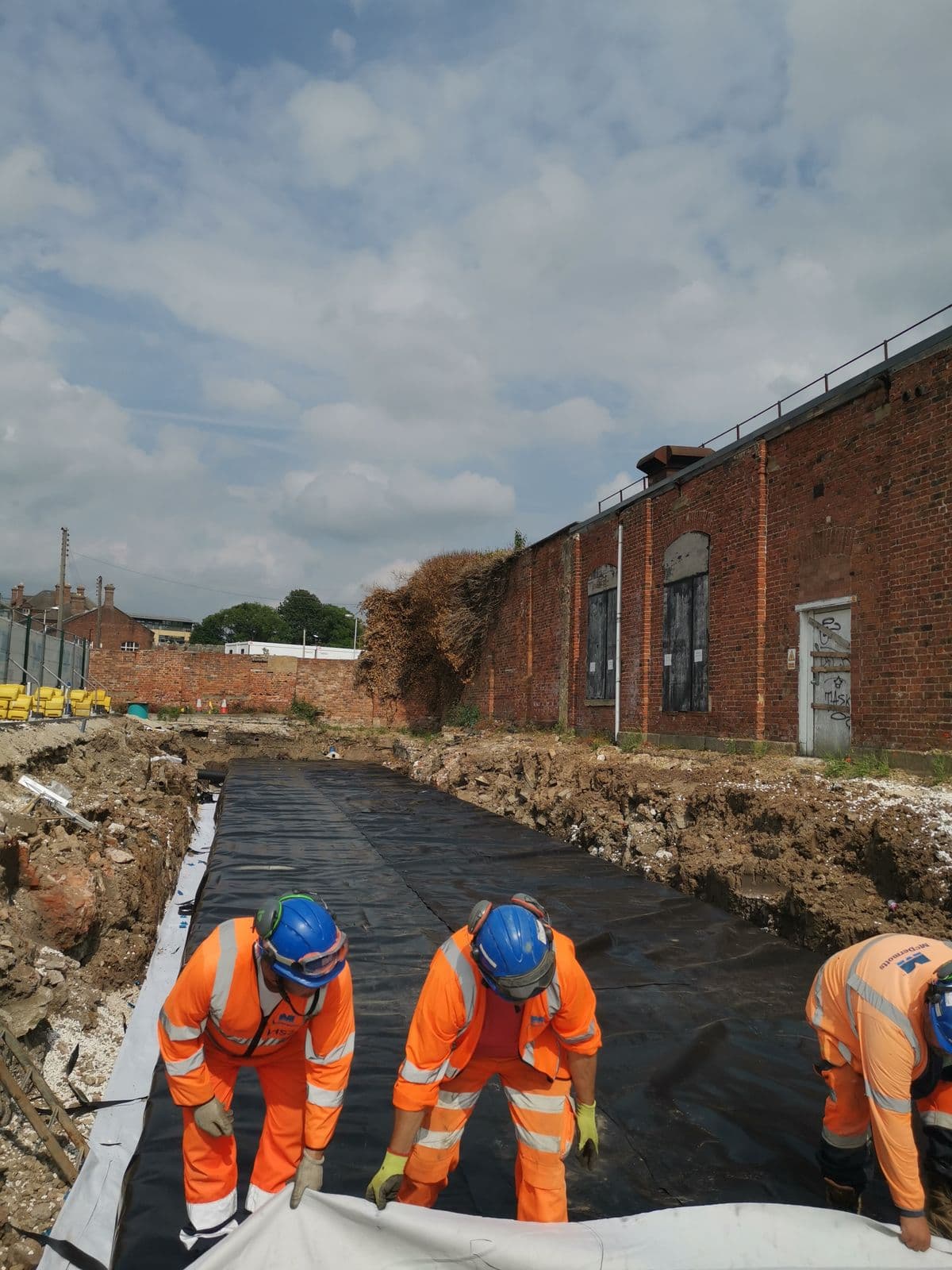
The groundworker trims and rolls the bed. A clay liner can't bridge a hollow or ride over a stone, so we go over the surface and accept it only when it is even and clean. Then:

  • Rolls deployed with generous overlaps
  • Bentonite paste or dry granules run along each lap before the next panel lands
  • Pipes, inlets and edges detailed in bentonite
  • A running record of each lap and detail

Handover and the cover layer

Along with the lap records, we leave a written cover depth for this product. Your contractor spreads that soil and then lets the water in, and in a district this wet the soil can't wait: rain soaking an uncovered GCL lets the clay swell unchecked, and it won't seal properly after that.

If your specification already names a GCL, we lay that one. If not, we suggest one; the NAUE, CETCO and Solmax products and the British-made Geosyn and Wrekin liners are all familiar to our crews.

Detailing round a stone headwall or an old culvert mouth, common in these valleys, is done with bentonite paste worked well into the joint, rather than relying on the panel alone.

Rolls stay wrapped and up off the ground until the moment they are laid, because a pallet of GCL left out in Bradford drizzle can start hydrating before it is ever unrolled.

GCL Pond Lining Bradford

Frequently asked questions

For a natural bed, simple detailing and self-sealing behaviour, where the banks are gentle and the liner will be fully covered. On steep or exposed ground, membrane is usually better.

Getting wet before it is covered is the risk. We plan the laying with your cover crew so the soil goes on promptly after handover.

No. GCL panels are overlapped and the laps sealed with bentonite paste or granules.

Yes, where the basin keeps a permanent pool and its sides are gentle. The engineer shapes it; we line the wet part and detail the inlets and outlet in bentonite.

Tell us about your project

Quote back within one working day