Skip to content

Galvanised Steel Tanks · South of England

Galvanised steel tanks in Dorset

Steel tank panels travel flat, which suits farmyards at the end of narrow Purbeck and west Dorset lanes. We supply and build lined galvanised tanks for irrigation, wash-down and process water on a base prepared by others.

Where we install
  • Sherborne
  • Sturminster Newton
  • Gillingham
  • Dorchester
  • Wareham
  • Swanage
  • Bridport
  • Poole
  • Ferndown

Base · Tamworth B78 2BP

Storage above the ground

Digging a large store into chalk is slow and costly, and near the coast a buried tank can sit in groundwater. An above-ground steel tank avoids both. It holds tens or thousands of cubic metres, stays accessible for inspection, and can be taken down and rebuilt elsewhere if the farm or site changes.

In Dorset these tanks mostly go on farms and growers' sites, with some on industrial land around Poole. A tank on a hilltop yard on the downs is also easy to see from a distance, so it is worth thinking about its height, diameter and position with the planners in mind.

  • Irrigation water for vegetable and arable growers on the chalk
  • Wash-down water for dairy units across the Blackmore Vale
  • Rainwater harvested off large sheds and packhouse roofs
  • Process and recycled water at industrial units in Poole and Ferndown
Why growers on the chalk store water

Chalk and sand both dry out fast in summer. Growers who irrigate need the water when the crop needs it, which tends to be the same weeks that the chalk streams run lowest. Filling a tank through the wetter months, from a licensed source or from shed roofs, puts that water in hand before the dry spell arrives. A steel tank sited near the field or packhouse also cuts the pumping distance at the point of use.

Getting it there and building it

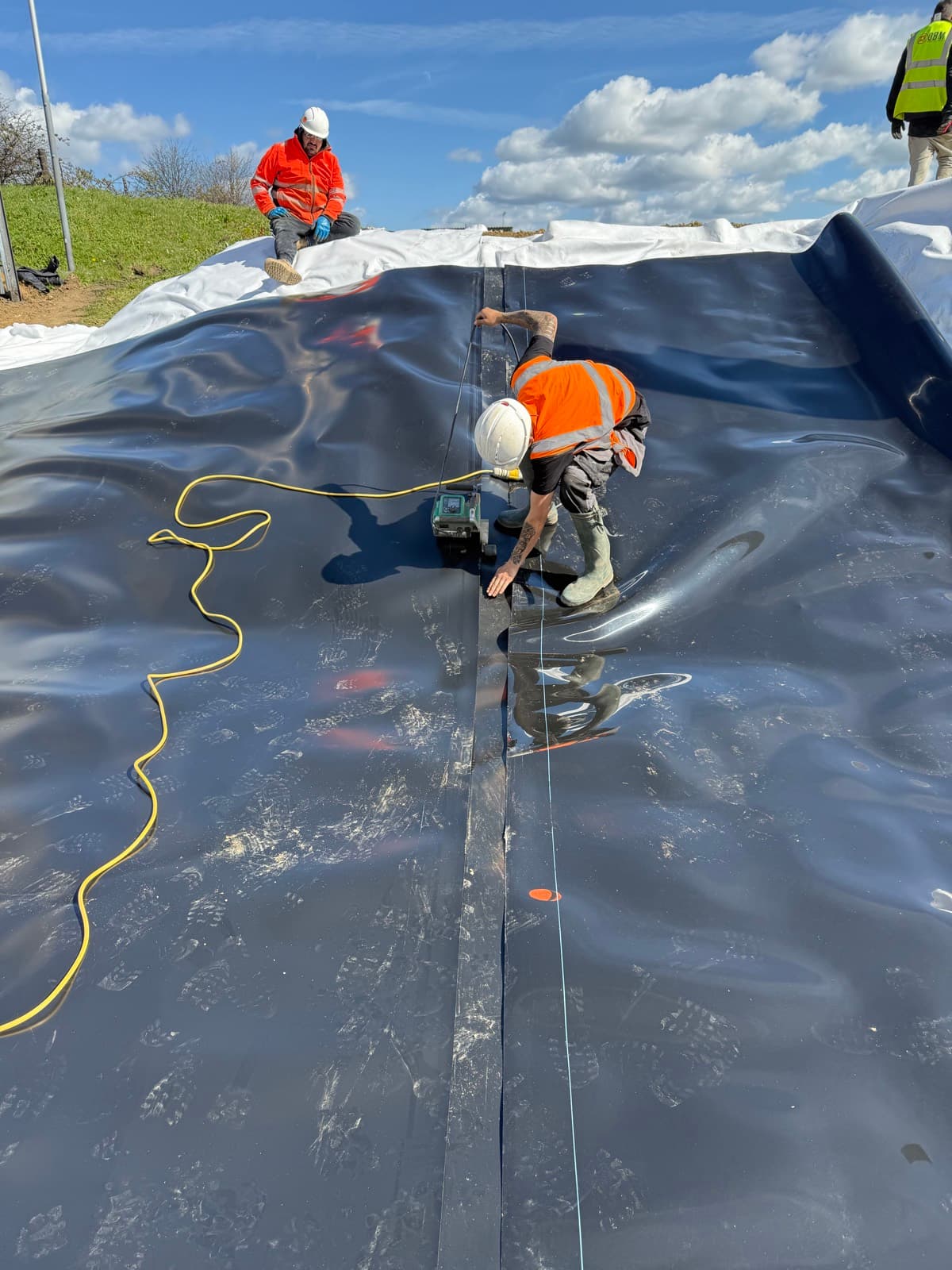
Panels travel flat on a lorry, so a tank can reach a yard that would never take a precast unit or a large crane. We assemble them ring by ring on site and bolt them together to the designed capacity, then fit the internal liner that makes the tank watertight. The water bears on the liner; the galvanised shell carries the load and never relies on the bolted joints to seal.

Pipe connections go in next: the feed, the draw-off, an overflow and a level gauge, each sealed where it passes through the liner. We fill the tank in stages and check every connection and the liner under load before it goes into service. On most jobs the build takes days once the base is ready.

The base comes first

The base is someone else's work: normally a concrete slab or an engineered pad designed to carry the tank brim full. Our first job on arrival is to survey that base for level and check the setting out. On a sloping chalk field or a soft clay yard, getting that base right is the single biggest factor in how the tank performs, so tell us early what the ground is like and we will set out what the tank needs from it.

Galvanised Steel Tanks Dorset

Frequently asked questions

Usually, because they travel flat and can come on smaller vehicles. Tell us about the access, including any weak bridges or tight bends, when you ask for a price.

Your groundworker or builder, working to an engineer's design for the weight of a full tank. Our crew surveys it for level before the first panel goes up.

Because the panels are bolted, the tank can come apart and go up again elsewhere, and with some designs extra rings can be added later. If moving or extending it is a real possibility, tell us at the start.

Tell us about your project

Quote back within one working day