Large parts of Liverpool's riverside, from the docks to Garston and Speke, stand on low-lying ground and made fill. Letting rainwater soak through a car park there risks flushing contaminants from the fill, or simply meets groundwater a short way down. Inland, glacial clay stops the water going anywhere.
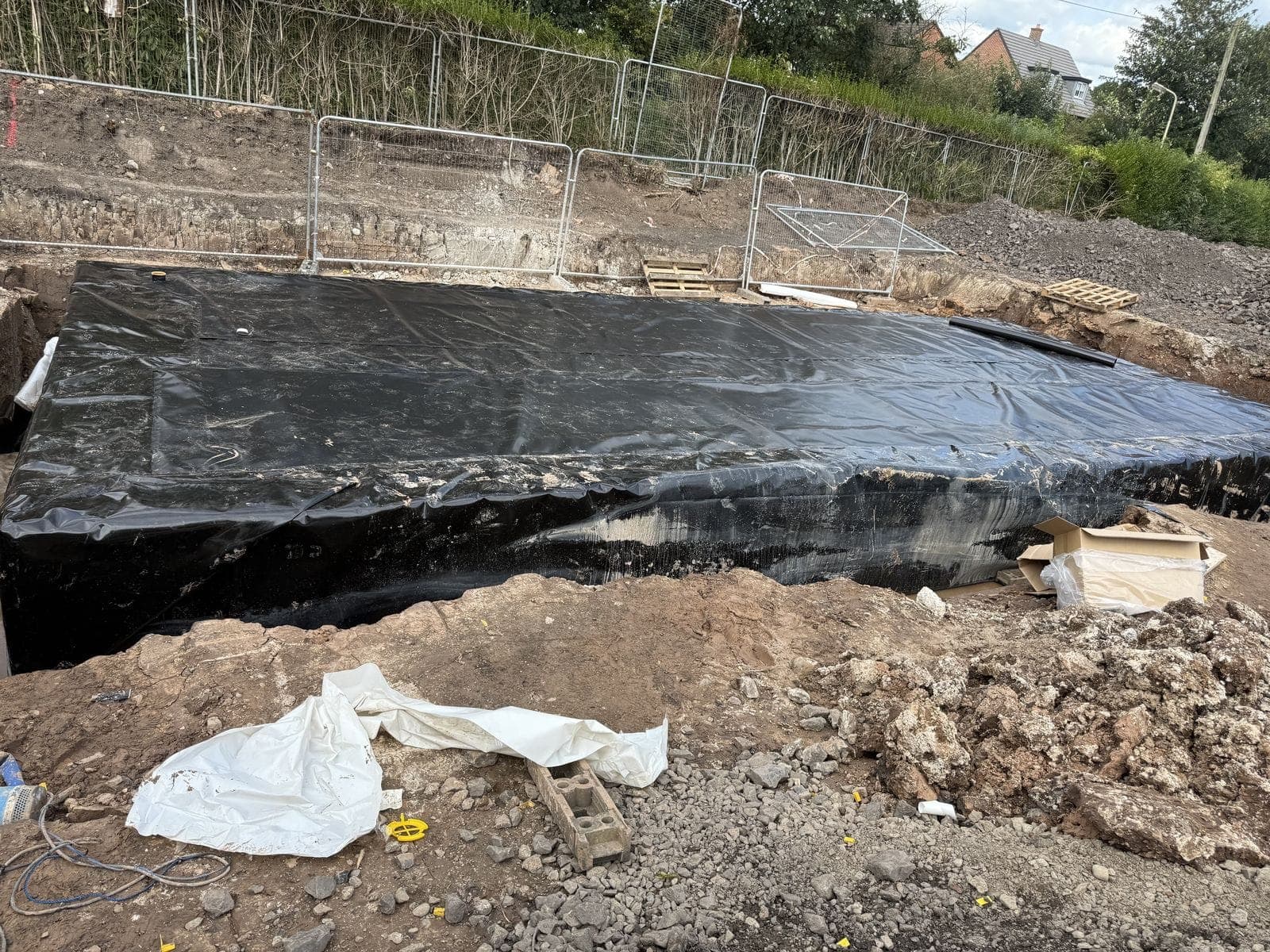
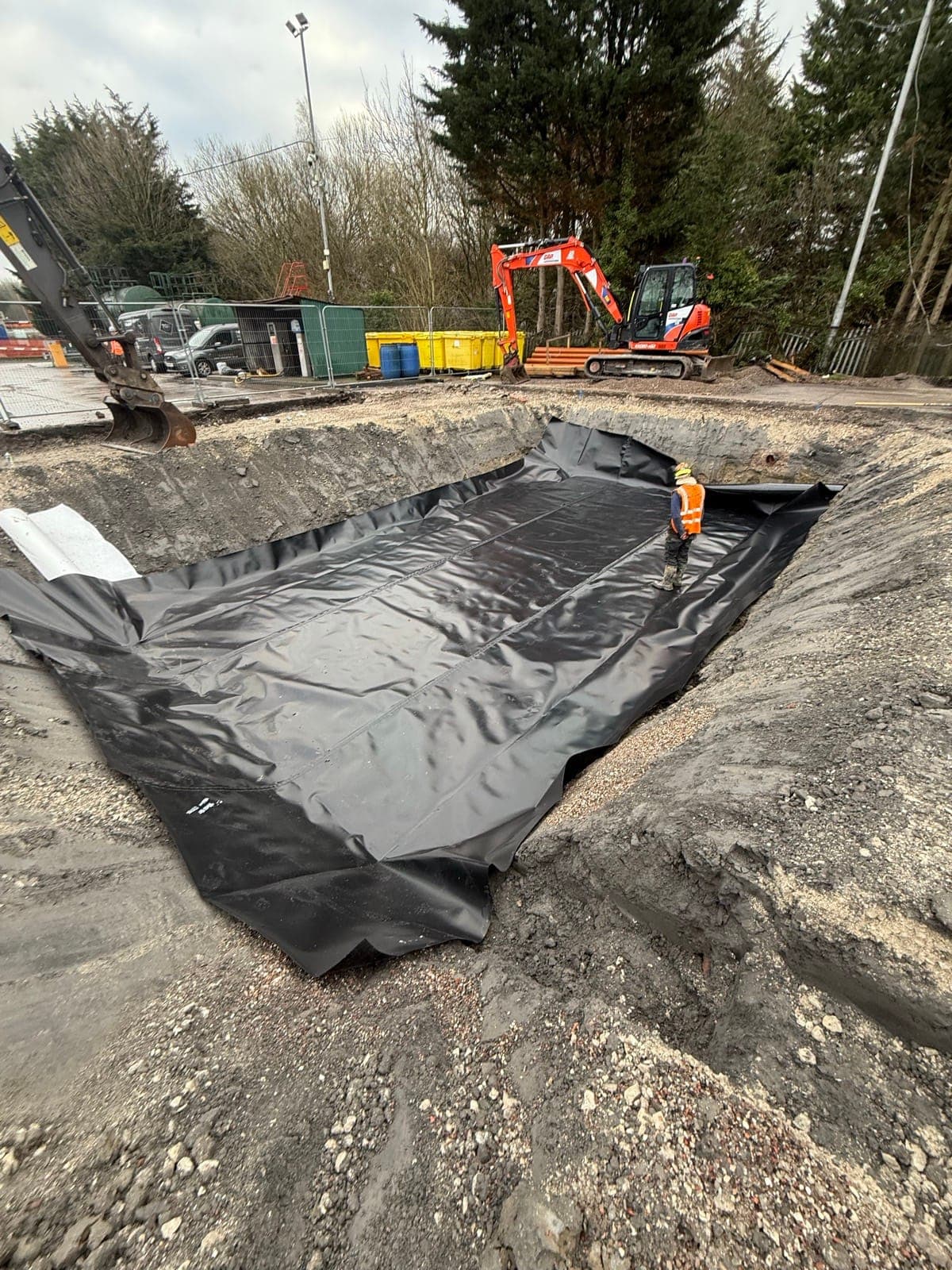
A lined permeable pavement deals with all three. The paving lets water in, the stone sub-base stores it, and the welded membrane beneath keeps it separate from the ground until a flow control releases it to the drainage.
Staff and visitor car parks at distribution parks, retail parks and supermarkets, hospital sites, and long-stay parking around Speke. On larger schemes the stone may not hold the whole storm, and crates go in below part of the paving to make up the difference. That is our work too, lined and logged together.
The excavation, trimmed to its falls, comes from your groundworker. We check it first, then line it.
- Fleece under and up the sides
- LLDPE, HDPE or PP, welded
- A logged test weld
- Outlets and crossings sealed
- Top fleece before the stone
The method matches the attenuation tank lining we carried out at Knowsley on a working industrial site: fleece first, an impermeable membrane heat-welded over it, details formed around the structures, then seams tested and recorded. On a car park the same discipline gives one unbroken sheet under all the paving, which we hand over with its weld log so the stone layer can go straight on.
On low riverside ground the excavation can take on water overnight, especially after rain. A membrane cannot be welded onto a flooded or muddy formation, and fleece laid in standing water gets dragged out of place. Your groundworker keeps the dig pumped dry; we look at it again each morning before any welding starts, and we adjust the day's area to what is ready.
Where the design has crates under the paving as well, we sequence the two so the tank and the car park lining are finished as one system before the stone goes on.
National policy, from the NPPF to Approved Document H and England's 2025 SuDS standards, nudges new schemes towards drainage at the surface that slows and cleans the runoff, and a lined permeable pavement does both inside the footprint of the car park. Merseyside's councils look over each scheme's drainage when it goes in for planning. The design is your engineer's; we make sure the membrane under it matches what was approved.