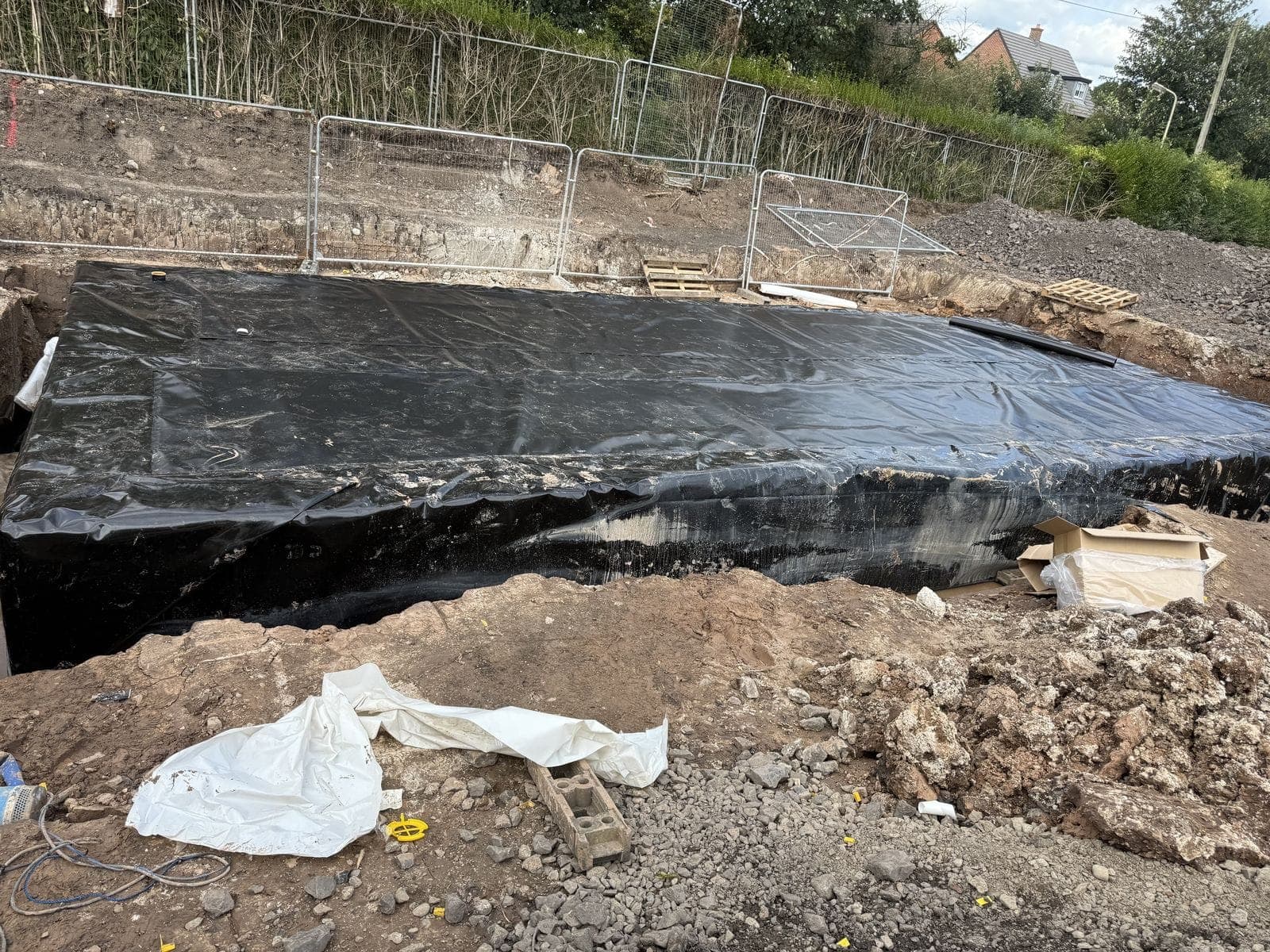
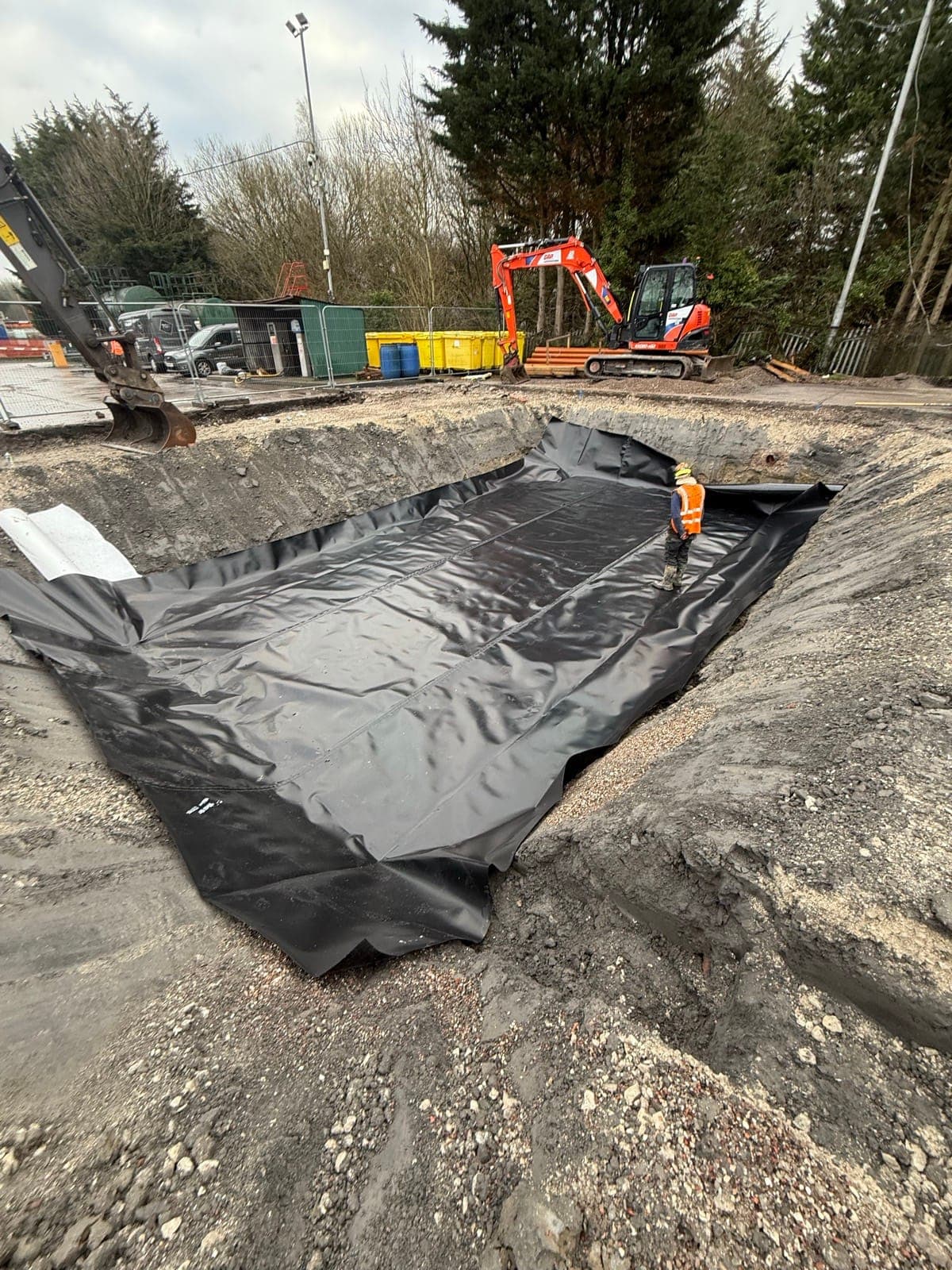
At Whittingham, near Preston, we built a 101m³ attenuation tank for the social club: 14m by 6m by 1.2m deep, in crates rated for heavy loading. 300gsm geotextile went across the formation, the impermeable membrane was welded over it, the crates were built to height, and the wrap was closed over the top with the connections sealed through it.
With a heavy-loading crate the wrap has to sit tight to the block. Loose folds get pinched when the cover goes on, and a pinched membrane is where a leak starts. We finish every tank with that in mind.
Preston sits on the Ribble, and the brooks that feed it run through the city and the farmland around it. Outside the urban area plenty of sites have no public sewer to connect to, so the tank releases water at a controlled rate to a watercourse instead. Farm diversification, equestrian buildings and rural commercial schemes across the Fylde and the Ribble Valley often drain this way.
New housing on the northern edge of the city, around Fulwood and Broughton, mostly goes onto former farmland. Roofs, drives and roads replace fields that used to soak up the rain, and the tank holds back what the fields no longer absorb.
Lancashire County Council is the lead local flood authority, and drainage conditions follow the Flood and Water Management Act 2010 and the NPPF. Your engineer sets the volume and discharge rate to satisfy them, and we build the tank to that design.
Industrial estates and logistics sites along the M6 and M55, including Walton Summit and Red Scar, have large roofs and yards that shed water fast. Tanks there often sit under service yards and HGV routes, so the crate's loading class matters as much as its volume.
Supply-and-install and install-only both work for us. The groundworker takes care of the excavation and backfill; we inspect what they've formed, put down the fleece and membrane, weld the joints, assemble a crate block with 95–97% void space and make the inlet, outlet and flow control watertight.
Before any tank is covered we carry out a test weld and record it. That record comes to you with the as-built details and our QA sign-off, ready for building control, the lead local flood authority or an adopting water company. If the tank is going for adoption, tell us at quote stage so the records are set up for it from day one.