
Skip to content

GCL Pond Lining · East of England

GCL pond lining in Cambridgeshire

Cambridgeshire's new towns and village extensions are building ponds as habitat, and a geosynthetic clay liner lets those ponds settle into a natural, planted bed. We lay GCLs with bentonite-sealed overlaps and leave them ready for your cover soil.

Where we install
  • Northstowe
  • Waterbeach
  • Cambourne
  • Huntingdon
  • Cottenham
  • Histon
  • Ely
  • St Neots

Base · Tamworth B78 2BP

Habitat ponds in growing places

Northstowe, Waterbeach, Cambourne and Alconbury Weald are adding thousands of homes on old airfields, barracks and farmland, with green corridors, wetlands and ponds woven through them. Ecologists want those ponds to look like they belong in the fen-edge landscape: soft margins, emergent plants, a clay bed and no visible plastic.

A GCL does that well. Its core is a thin mat of sodium bentonite stitched between two geotextiles. Wetted under a load of soil, the clay thickens into a barrier water can barely pass, and small holes from roots or burrowing animals close up on their own.
Chalk water and fen peat

Two local conditions need thought before choosing clay. Water from the chalk is hard, and calcium can gradually replace the sodium in the bentonite, which makes it less effective. On the fen edge, peat soils are soft and organic and can settle, and some pond profiles there are too steep to keep cover soil in place.

We run a suitability check on every job for these reasons. If clay is wrong for the site, a welded membrane is the alternative, and we install those as well.

Laying, sealing and handing over

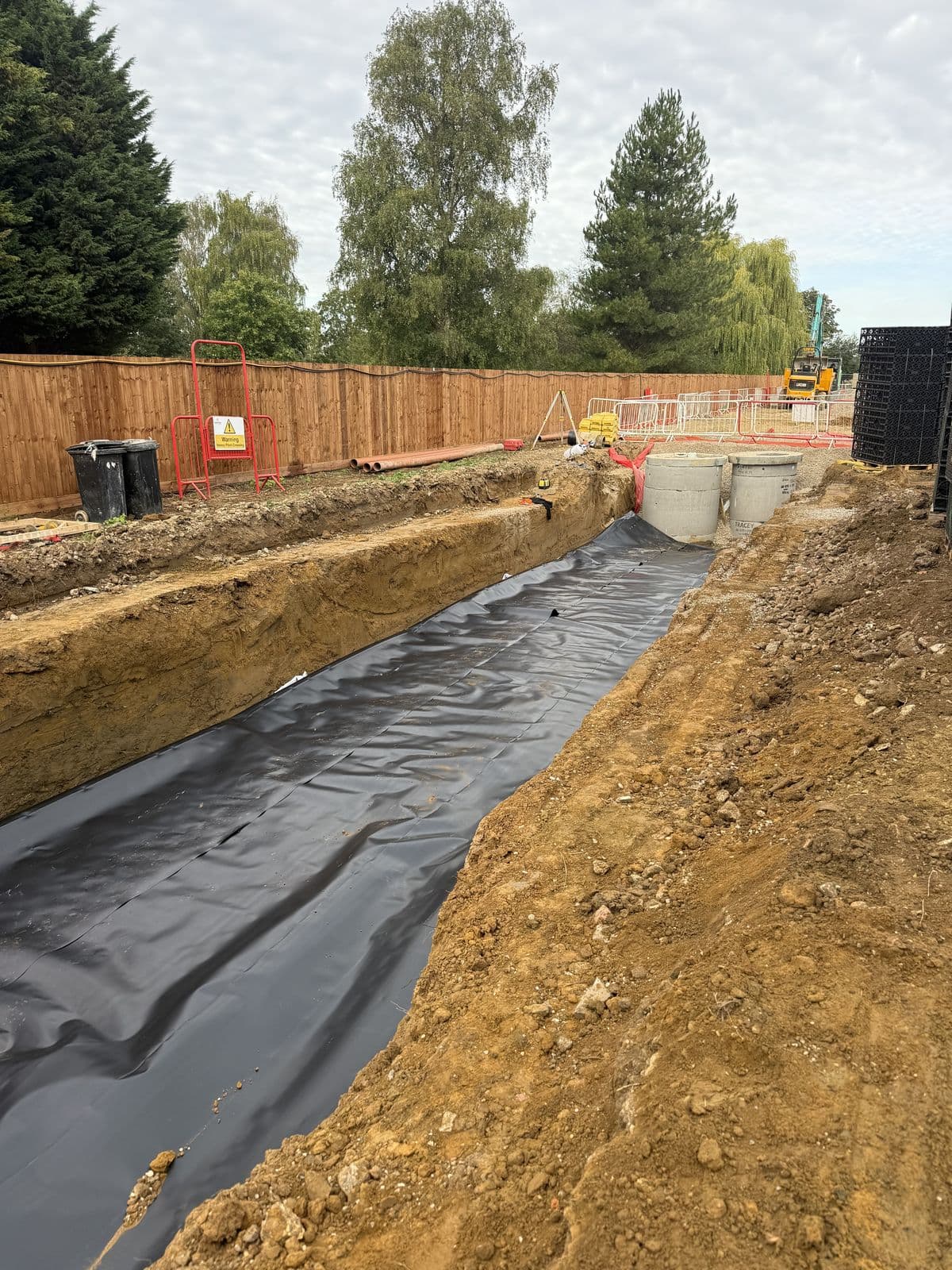
Once your contractor has shaped and compacted the formation, we inspect the surface and approve it, picking out flints and roots that are common in chalky ground. Rolls run down the slope with generous laps, each lap dressed with bentonite paste or loose granules. Around an inlet, an outfall pipe or a boardwalk post we build a bentonite collar by hand.

Every lap and detail goes on our sheet as it is finished, and the QA records state how deep the soil over this GCL must be. Placing that soil and wetting the liner is then down to your contractor, ideally the same week. A Cambridgeshire downpour landing on bare GCL before it is buried will swell the clay with nothing to press against, and the panel is lost.

Fitting in with the landscape works

On a new settlement the pond is usually one item in a long landscape package. We slot in between the shaping and the soiling, so the liner is laid and recorded in a short visit and the landscapers can carry on.

GCL Pond Lining Cambridgeshire

Frequently asked questions

Often, yes. Marginal and aquatic plants root straight into the clay, and the liner suits the shallow, gently sloping ponds newts prefer. Your ecologist sets the design; we confirm the liner suits it.

Possibly, but hard water affects bentonite over time. Tell us the water source at the start so the product and cover depth can be chosen with it in mind, or a membrane used instead.

We follow the ecologist's pond design and timings. If something in the profile or water supply worries us for a clay liner, we raise it with them and with you before laying.

The landscape or groundworks contractor, as soon as our records are signed. The required depth is written on them.

Tell us about your project

Quote back within one working day