
Skip to content

Soakaway Tanks · East of England

Soakaway installation in Cambridgeshire

In Cambridgeshire a soakaway works on the chalk south of Cambridge and on the gravel terraces of the Ouse and the Cam, and seldom anywhere else. Where the percolation results come back good, we install geocellular soakaways built to your engineer's design.

Where we install
  • Sawston
  • Linton
  • Cambridge
  • St Ives
  • Huntingdon
  • St Neots
  • Godmanchester
  • Great Shelford
  • Fulbourn

Base · Tamworth B78 2BP

Where infiltration has a chance

The chalk rises gently south and east of Cambridge, towards Sawston, Linton and the Gog Magog Hills, and it can drain freely. Sand and gravel left by the rivers underlie parts of St Ives, Huntingdon, St Neots and the villages along the Cam, and they can drain well too, provided the water table is low enough.

Across the fenland of the north and on the gault clay that runs through the middle of the county, a soakaway rarely passes. Peat and silt sit over high groundwater, and the clay barely lets water through. On those sites your engineer will normally specify attenuation instead.
Chalk and drinking water

The chalk under south Cambridgeshire is an important aquifer for public supply, and the Environment Agency defines source protection zones around the boreholes that draw from it. Inside those zones, discharging runoff into the ground can be restricted or need extra treatment upstream.

That check sits with your engineer at design stage, together with the percolation test at the depth of the soakaway and the highest recorded groundwater level.

Building it into the dig

We go through the design and the test results before your groundworker excavates, and question anything that doesn't fit, such as a base that would sit in seasonal groundwater on a gravel site. Your groundworker digs the pit and forms the base; we check it is level and clean before starting.

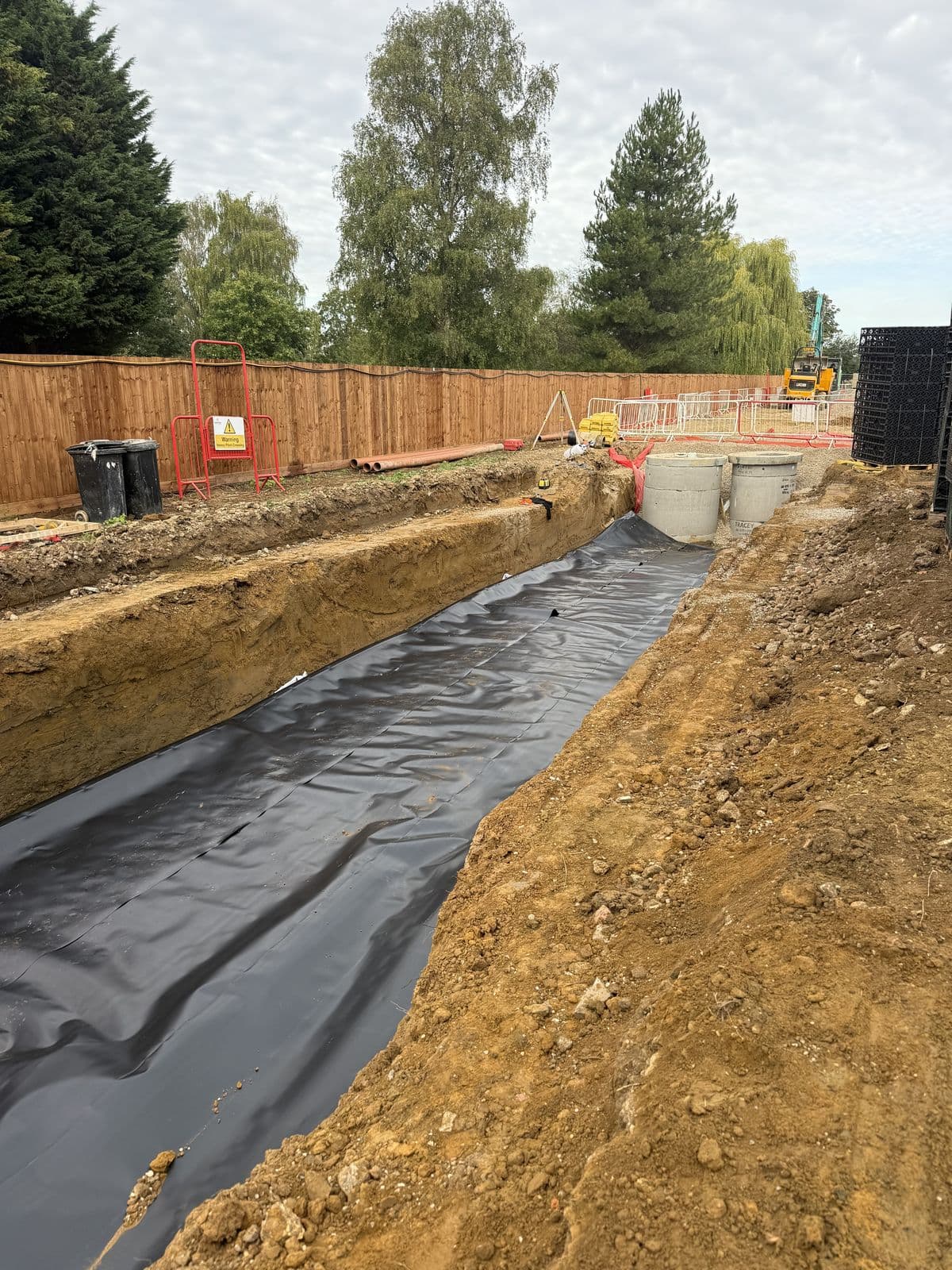
A permeable geotextile goes round the pit first; water passes through it freely, but silt and chalk fines stay outside the crates. Crates are assembled inside to the designed volume and loading class, the inlet is connected along with any catchpits or filters upstream, and the wrap is closed over the top. The finished soakaway is handed back closed and ready for your backfill, and building control gets our inspection sheets and handover pack.

  • Driveway and roof soakaways on chalk village plots
  • Larger soakaways under car parks on gravel sites
  • Install-only, using crates and geotextile you have bought

Keeping it working

The crates need no attention once buried. What fails a soakaway is silt, so the catchpit or filter upstream should be lifted and emptied on a routine, especially where a drive or yard drains chalky or sandy grit into it. Silt that gets past a neglected catchpit into the crates can only be removed by digging them up.

Soakaway Installation Cambridgeshire

Frequently asked questions

Usually not. Fen ground holds water close to the surface, and a soakaway needs its base well above the water table all year. The percolation test and groundwater readings decide; if infiltration fails, an attenuation tank is the normal alternative.

Your engineer or site investigation team. We install to their results and design, and we can supply the crates and geotextile.

Chalk can dissolve and form voids, and it sits over drinking water in places, so your engineer looks at both before choosing infiltration. Our part is to build the soakaway to their design and keep fines out of it.

Tell us about your project

Quote back within one working day