Cambridgeshire is one of the flattest parts of England. The Fens in the north are low-lying, much of the land sits at or close to sea level, and it's kept dry by pumped drainage. The Great Ouse, the Nene and the Cam all run through the county, and the fen soils of peat and silt sit over high groundwater.
That makes infiltration hard across much of the county. A soakaway needs a dry base well above the water table, and on fen and gault clay sites there often isn't one. The chalk south and east of Cambridge can drain well, but on most fen-edge and clay sites surface water has to be stored and released slowly.
Cambridgeshire County Council and Peterborough City Council are the county's Lead Local Flood Authorities, a role created by the 2010 Flood and Water Management Act; they are consulted on surface water drainage for major developments. Planning conditions fix the drainage strategy and the discharge rate, guided by the NPPF and, since June 2025, the national SuDS standards.
Much of the fenland is looked after by Internal Drainage Boards, whose consent is generally needed to discharge into the watercourses they manage, and Anglian Water is the sewerage company across the county. Those approvals sit with the developer and their engineer. We build what the approved design asks for.
An attenuation tank stores runoff below ground during a storm and lets it out through a flow control at the rate the planning conditions allow. On many Cambridgeshire sites it's the main storage in the SuDS scheme, often sitting downstream of permeable paving, swales or a basin.
Where groundwater is high, the tank has to stay sealed. We wrap the crates in a 300gsm protective fleece and an impermeable membrane whose joints are all heat-welded rather than taped. We make and log a test weld before the groundworker backfills.
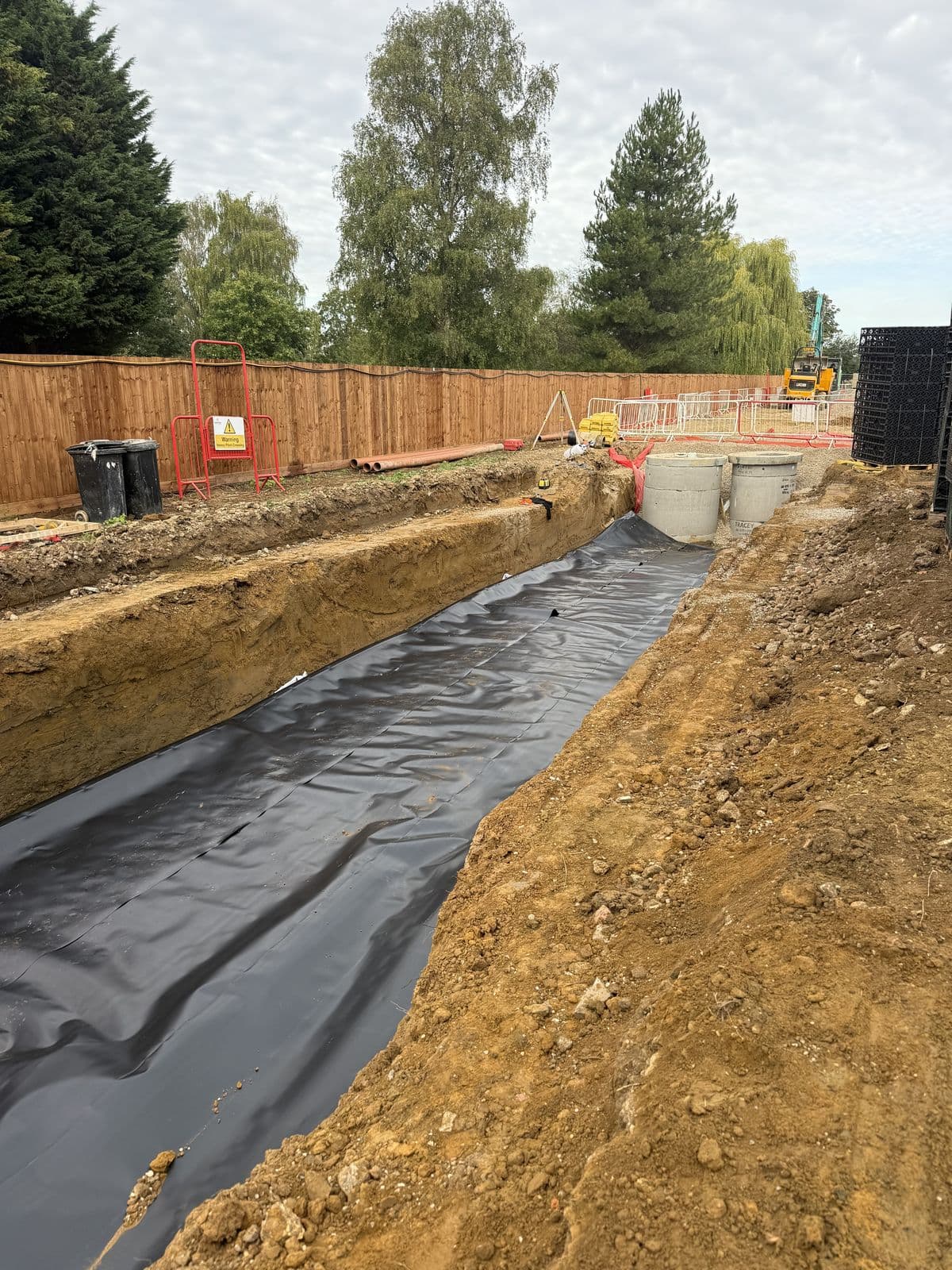
Tight sites call for long, narrow tanks. At Cottenham, on the fen edge north of Cambridge, we built a 51.5m linear attenuation tank only 2m wide and 0.8m deep, about 82m³ of storage in a trench beside a new development.
The 0.75mm LLDPE membrane ran the full length of the trench, and the two 300mm fittings and the 110mm vent were detailed by hand so the wrap stayed continuous end to end. It went back to the groundworker wrapped, sealed and ready for backfill.
You can have us supply the materials as well as fit them, or hand us crates and membrane you've sourced elsewhere. We don't design, dig or backfill. On site, we cover:
- A formation check on the excavation your groundworker has dug
- Fleece and membrane cut and dressed to the tank
- A crate block built up to the storage and load rating on the drawings
- Inlet, outlet and flow-control connections to the drainage design
- A QA file and handover documents for building control and whoever adopts the tank