
Skip to content

Pond Lining · East of England

Reservoir and pond lining in Cambridgeshire

The Fens grow vegetables and salad crops that need water in dry summers, and storing winter water in a lined reservoir is how many farms do it. We weld liners into reservoirs, ponds and lakes across Cambridgeshire, from field-scale stores to small garden ponds.

Where we install
  • Wisbech
  • March
  • Chatteris
  • Whittlesey
  • Ely
  • Littleport
  • Ramsey
  • Soham
  • Peterborough

Base · Tamworth B78 2BP

Winter water for fenland farms

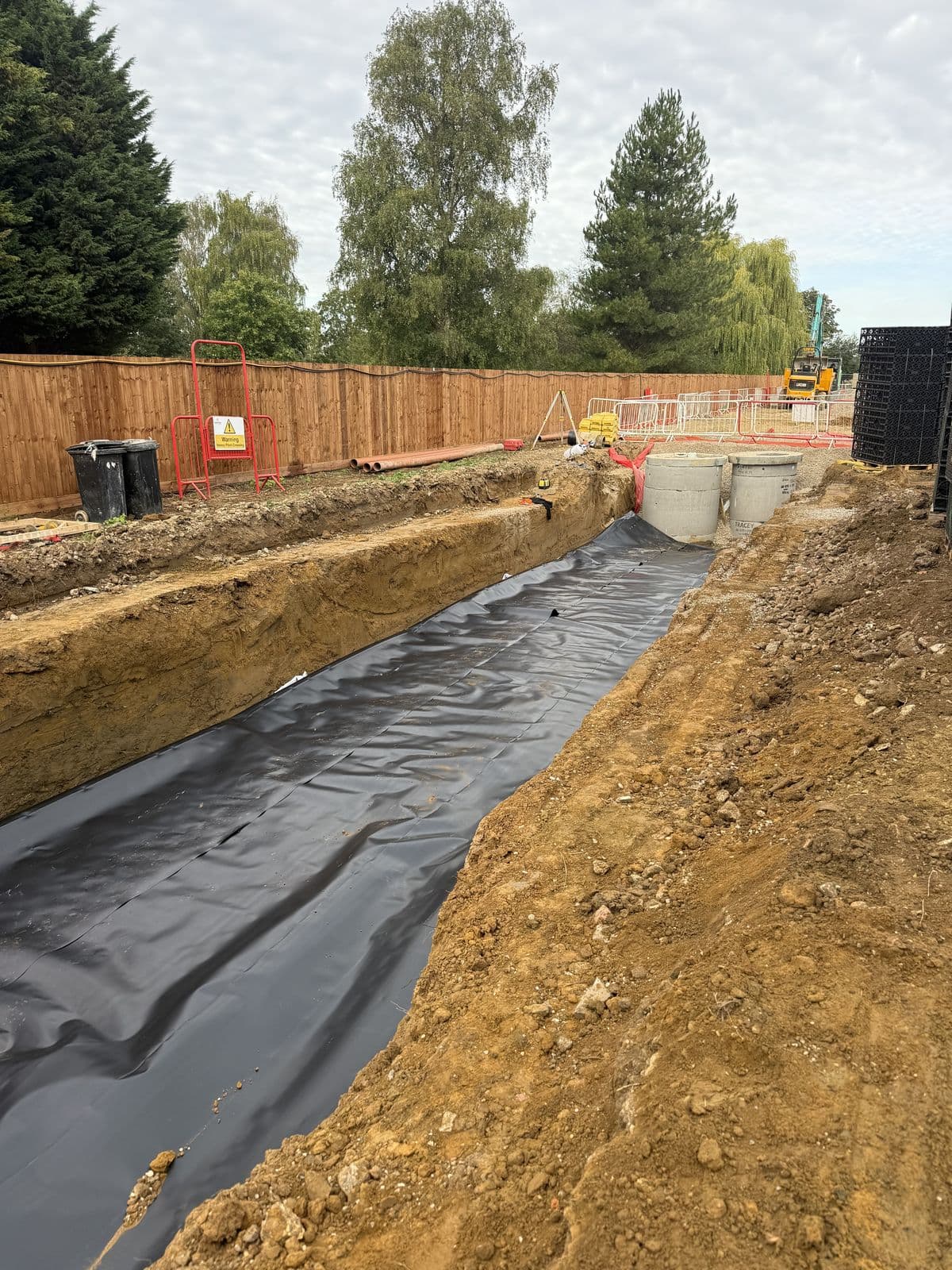
A typical fen reservoir is a broad, shallow embankment holding water pumped in during the winter months for use on crops in summer. It covers a large area, so the liner is usually HDPE or LLDPE in big welded panels, chosen for strength and resistance to sunlight on the exposed upper slopes. Panels the width of a field are joined on the base, so the long seams are the bulk of the work.

Fen peat also moves. As it dries it shrinks, and the ground can settle unevenly over the years. A flexible welded liner on a protective underlay copes with that kind of movement far better than a rigid structure or compacted clay.
Wind across open country

There is very little shelter on the Fens, and a loose panel of membrane behaves like a sail. We plan deployment around the forecast, unroll panels in the lee of what is already down, and weight and weld them in sequence so nothing is left flapping. Anchor trenches at the crest are cut and backfilled as soon as each run is welded.

Other ponds across the county

Away from the farms the work is closer to home:

  • Balancing and amenity ponds on new developments around Cambridge, Huntingdon and Peterborough
  • Ornamental lakes on estates and in large gardens on the chalk
  • Fishing pools in the river valleys
  • Relining of older ponds that no longer hold water

Choosing between sheets

Garden and wildlife ponds on the chalk villages usually take EPDM, which is soft enough to follow shelves and planting ledges by hand. Reservoirs and big lakes go to HDPE or LLDPE. PP comes in where there are many pipes, steps or tight corners to detail. On a confined, gently shaped wildlife pond a bentonite clay liner may be the better answer, and we lay those too.

Welding and checks

Your contractor builds the banks and trims the formation. We inspect it, lay a geotextile underlay, then wedge-weld the panel seams and use an extrusion welder at pipes, pump sumps and corners. A test weld is made on every job and its result written into the handover file alongside the seam log.

Pond Lining Cambridgeshire

Frequently asked questions

Both are used. HDPE is tough and resists sunlight on exposed slopes; LLDPE is more flexible and follows ground movement more easily. The size, slope and exposure of the reservoir decide it.

A welded sheet on a protective underlay can stretch with gradual settlement, which is one reason flexible membranes suit fen reservoirs. Sudden movement or a failing bank is a different matter, and your engineer designs the embankment to avoid it.

No. Your earthworks contractor builds the embankment and forms the anchor trench line. We check the formation and install and weld the liner.

Abstraction licensing and planning are for you and your advisers to arrange. We line the reservoir to the design and hand over the weld records.

Tell us about your project

Quote back within one working day