
Skip to content

Gas & Hydrocarbon Membranes · East of England

Gas and hydrocarbon membranes in Cambridgeshire

Much of Cambridgeshire's new building is going on to land with a past: wartime airfields, worked-out brick pits and organic fen soils. Where the ground investigation finds gas or fuel residues, we install the membrane the design specifies, sealed and detailed around every penetration.

Where we install
  • Northstowe
  • Alconbury Weald
  • Waterbeach
  • Peterborough
  • Whittlesey
  • Huntingdon
  • Cambridge
  • Yaxley

Base · Tamworth B78 2BP

Airfields and barracks becoming towns

Northstowe is going up on the former RAF Oakington, Alconbury Weald on an old airfield near Huntingdon, and Waterbeach on former barracks land. Fuel stores, hangars and workshops can leave hydrocarbons in the soil, and where the investigation finds them the design calls for a hydrocarbon-resistant barrier under the new buildings.

Large sites like these are built out in phases over many years, so the same membrane specification may be laid on dozens of plots by different trades. A consistent installer and a consistent set of records make the warranty file far easier to keep.
Brick pits, peat and made ground

Around Peterborough and Whittlesey the Oxford Clay was dug for brickmaking on a huge scale, and some of the old pits were later filled with waste. Land near former fills can carry methane and carbon dioxide. Peat on the fen edge decomposes and can give off the same gases, and made ground on brownfield plots in Cambridge, Huntingdon and Peterborough brings its own uncertainty.

Radon is generally lower here than in some neighbouring counties, but the assessment for each plot decides. When a gas regime is identified, the design follows BS 8485. Gas concentrations and flow rates from the monitoring set the characteristic situation, and that in turn sets how much protection the building needs.

Installation that stands up to inspection

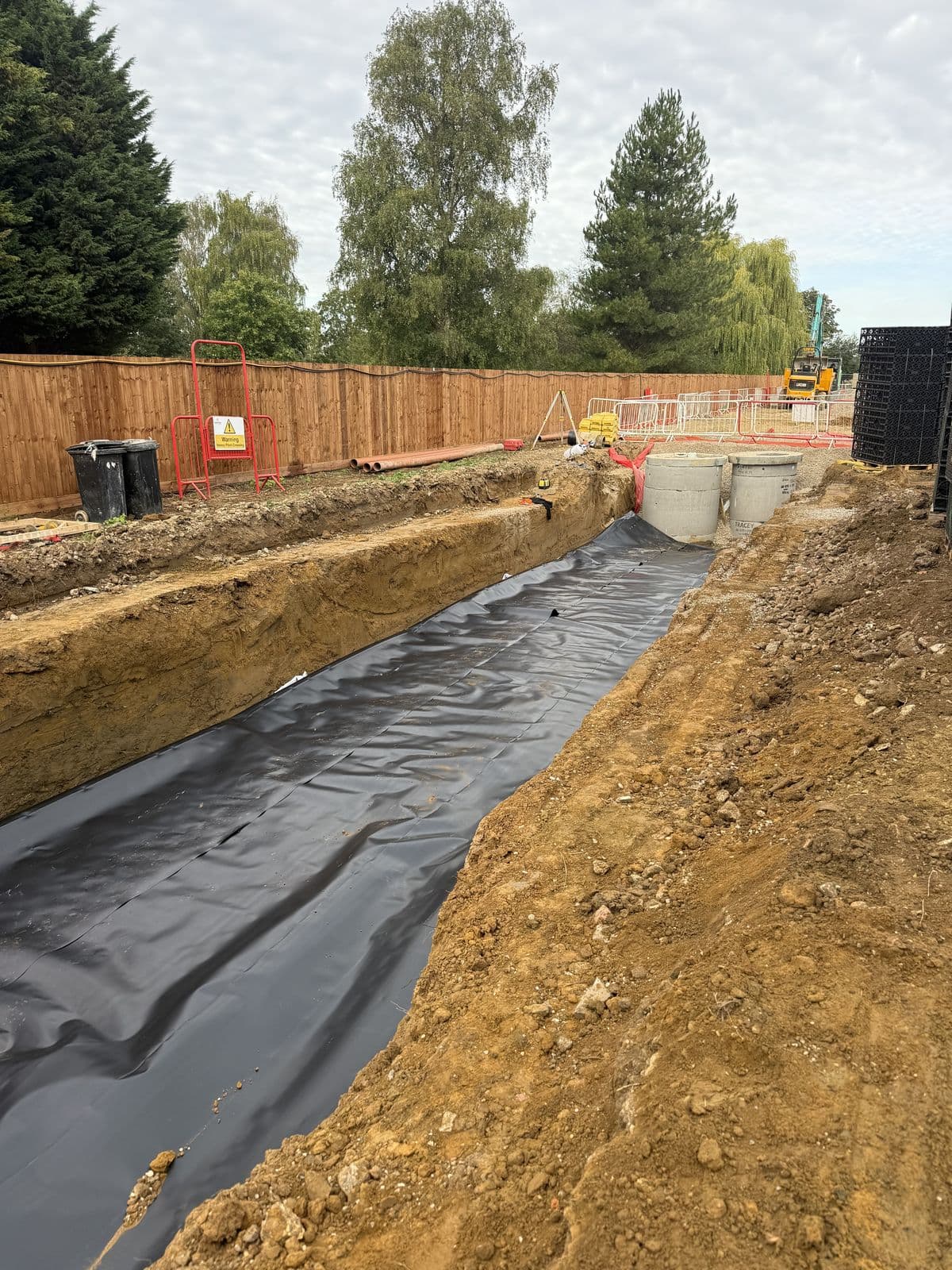
We work from the gas risk assessment and the membrane specification. The blinding or slab is checked first, and anything that could puncture the barrier is flagged before laying. On these Cambridgeshire slabs the laps are welded, or sealed, in whichever way the named product's specification demands, and every pile, service duct and drainage connection gets its own collar. We also flag any service that turns up after the membrane is down, because a pipe pushed through later is the classic hole in a gas barrier.

An independent verifier can be booked to inspect and test the finished barrier, something many warranty providers expect on larger schemes. Our installation records go to you for the warranty file.

  • Hydrocarbon barriers on former airfield and depot land
  • Methane and carbon dioxide protection near old fills and peat
  • Radon protection where the plot assessment requires it

Gas Membrane Installation Cambridgeshire

Frequently asked questions

Not automatically. The ground investigation measures gas and flow rates, and the design follows from that. Thick organic soils often lead to a protection requirement, so it is worth testing early.

Where hydrocarbons are found, the specification names a membrane that resists them. We install that product with sealed laps and penetrations as the design requires.

Yes. On big phased schemes we come back as each group of plots is ready, so the membrane goes down between slab preparation and the first lift of blockwork, and each visit adds to the same set of records.

Integrity testing and independent validation are available. We arrange them alongside the installation so the certificate is ready when the slab goes on.

Tell us about your project

Quote back within one working day