
Skip to content

GCL Pond Lining · East Midlands

GCL pond lining in Nottingham

Ponds dug into Nottingham's sandy ground need a sealing layer the site can't supply on its own. A bentonite clay liner gives them a natural bed, and we lay it for ecologists, landscape architects and housebuilders across the conurbation.

Where we install
  • Nottingham
  • Beeston
  • Attenborough
  • Gedling
  • Colwick
  • Clifton
  • Ruddington
  • Hucknall
  • Bingham

Base · Tamworth B78 2BP

A clay bed where the ground is sand

Dig a pond into Sherwood Sandstone or Trent gravel and it empties. Puddling it with clay the old way needs a source of good clay and a lot of compaction. A GCL packs that seal into a roll you can carry on a telehandler: sodium bentonite held between two geotextiles, swelling when wetted into a very tight barrier.

Ecologists like it for great crested newt and mitigation ponds because the finished bed looks and behaves like clay. Plants root into the soil cover, and if a root or a heron's beak does nick the liner, the bentonite swells into the hole.
Checking the water first

A GCL isn't right for every pond, and around Nottingham the reason is often chemistry. The Mercia Mudstone east of the Trent carries gypsum, and water that has run through it can be rich in calcium, which over time can stiffen sodium bentonite and weaken its seal. Ponds fed by hard groundwater or field drains deserve the same question.

So before recommending GCL we ask what will fill the pond and what drains into it. If the chemistry, steep banks or exposed edges count against it, we'll say so and suggest a welded membrane instead. We install both.

Where these ponds are going in

Most of our Nottingham GCL enquiries come from new estates on Nottingham's outskirts, where planning asks for a mitigation or wildlife pond in the open space. Others come from restoration of old ground: former gravel workings in the Trent valley, landscaped colliery land, and country parks that want a pond without a plastic edge showing.

Laps, paste and cover

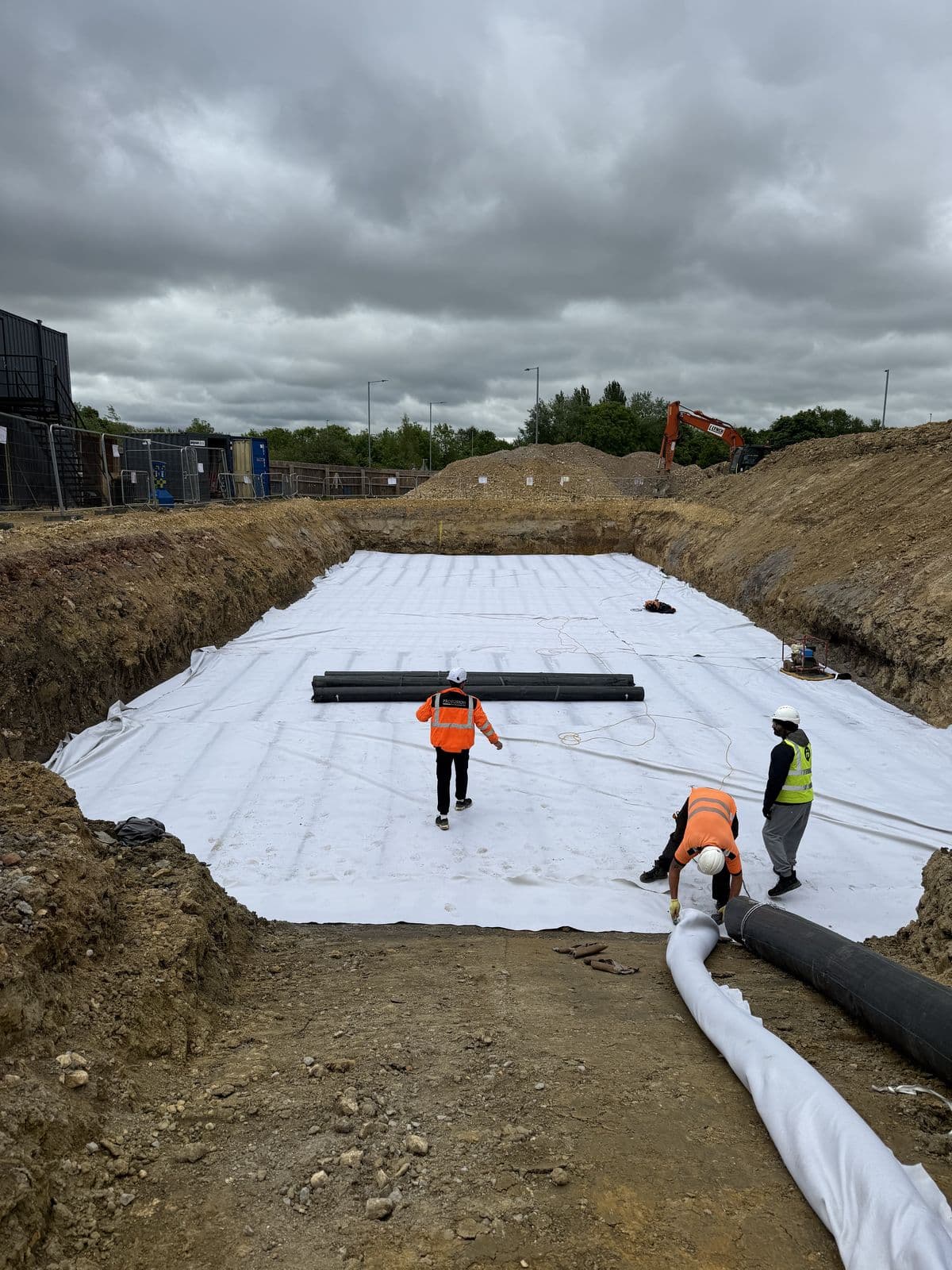
Shaping the hole is your groundworker's job; they leave us a smooth, firm formation with flints, roots and rubble taken out. We walk it and sign it off, then unroll the panels with wide overlaps, bedding bentonite paste or granules into each one. Inlets, outlets and the pond edge are dressed the same way, and our log notes every lap and detail on the day.

Timing matters on the wetter Trent valley sites. Bentonite that hydrates before it's confined is spoilt, so we hand over with the required cover depth and your contractor places the soil layer straight after.

GCL Pond Lining Nottingham

Frequently asked questions

Yes. A smooth, compacted sand formation suits it well. The liner supplies the clay layer the sandstone lacks, provided it is covered and confined once we hand over.

Your contractor, the moment we've finished. We give them the minimum soil depth for the product. Wetted without that weight on it, the clay simply swells, softens and drifts away.

Yes, bentonite is simply a clay mineral. Under its soil cover the bed ends up much like the clay-puddled field ponds newts have used for generations.

Bentofix from NAUE, Bentomat from CETCO, Solmax's GCL, and rolls from the UK makers Geosyn and Wrekin, either as specified or as we'd recommend for the pond.

Tell us about your project

Quote back within one working day