
Skip to content

Attenuation Tanks · East Midlands

Attenuation tank installation in Nottingham

We supply and install sealed crate tanks for Nottingham developments whose drainage design holds the storm and lets it out slowly. Riverside plots, brownfield land inside the ring road and estates on the clay south of the Trent are where most of them end up.

Where we install
  • Nottingham city centre
  • The Meadows
  • West Bridgford
  • Clifton
  • Beeston
  • Gedling
  • Arnold
  • Hucknall
  • Carlton
  • Long Eaton

Base · Tamworth B78 2BP

A sandstone city that still needs sealed storage

People expect a city built on Sherwood Sandstone to soak up its own rain, and in places it can. Yet a lot of Nottingham's development land isn't on clean rock. The Meadows, Colwick and the riverside towards Clifton Bridge sit on Trent gravels where the water table is close below the surface. South and east of the river the sandstone gives way to Mercia Mudstone, which barely drains at all.

In the centre, the rock is riddled with cellars and hand-cut caves and capped with old made ground. An engineer is rarely keen to pour concentrated roof water into that. So the design stores it in a wrapped crate tank and meters it out through a flow control to the sewer, the Leen, the Day Brook or another local outfall.
The jobs we see around Nottingham

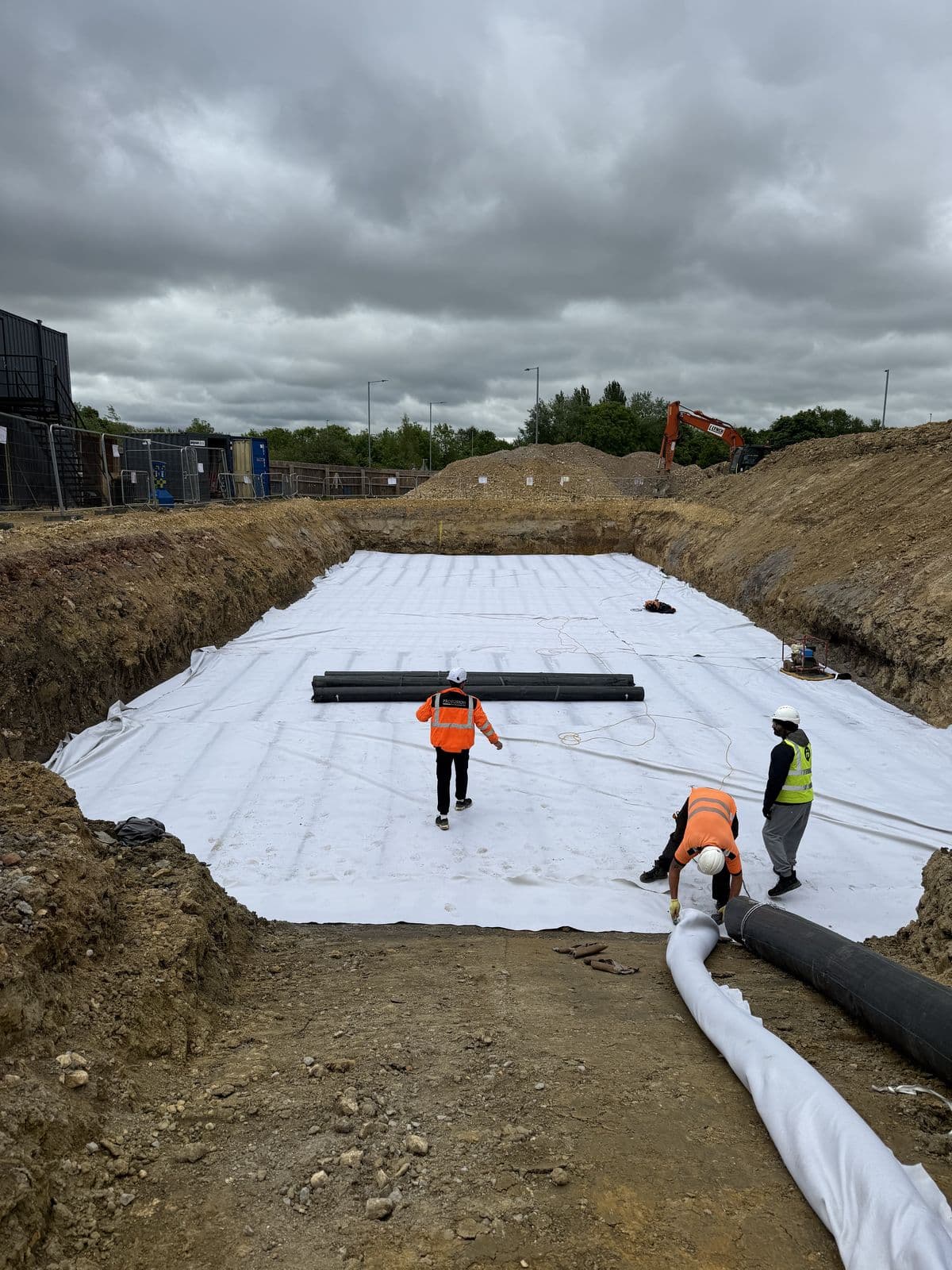
Tanks here go under all sorts of surfaces, and because crates are modular, the layout follows whatever footprint the drawing allows: an L-shape round a lift core, a narrow strip beside a boundary wall, or a broad block under a yard.

  • Regeneration plots along the Trent and the canal, often with a podium or car park on top
  • Urban extensions on the city's edge, from Clifton and Edwalton round to Gedling and Hucknall
  • Warehouse and trade-counter yards near the M1 junctions to the west
  • School, college and hospital campuses where the tank sits under a playground or service road

Working in a wet dig on the gravels

On the Trent terraces an excavation can take on water within hours of being opened. Membrane can't be fused while it's wet, so the groundworker keeps the pit pumped down while we deploy fleece and liner, and we join each panel as it goes in. If water is rising faster than it can be cleared, we stop and say so rather than bury a seam we aren't sure of.

High groundwater also tries to lift an empty tank. Flotation checks, anchoring and cover depth belong to your engineer. Our wrap does the other half of the job: it keeps the river's groundwater out of the storage volume, so the tank holds only what the drainage sends it.

Records that stay with the site

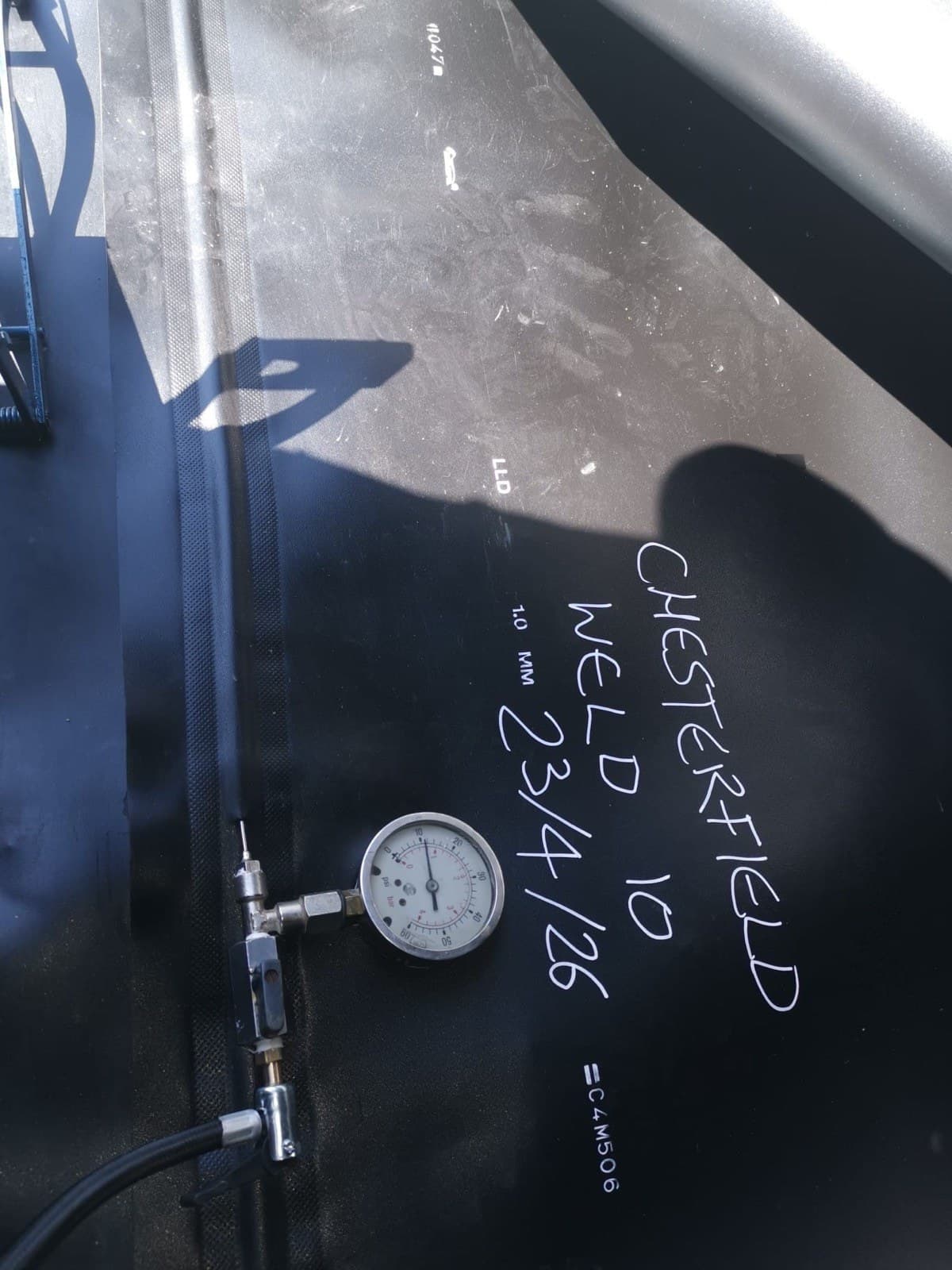
Every joint in the Nottingham membranes we lay is fused with hot-wedge or extrusion kit; tape never comes out of the van. Before the groundworker starts to backfill, we cut a trial weld, check it and enter it in the job log. Building control, the adopting body and the warranty provider then get one QA and handover pack. Up the M1 at Chesterfield, our attenuation tank went in with each weld numbered and pressure-tested, and Nottingham clients receive that standard of record.

Attenuation Tank Installer Nottingham

Frequently asked questions

Usually because the site is on Trent gravels with shallow groundwater, on mudstone, or on made ground the engineer doesn't want saturated. The design decision is theirs; we build the tank they've drawn.

Yes, install-only is routine for us. When the delivery lands we look it over and flag anything that might change the number of welds or put the manufacturer's warranty at risk.

From our Tamworth base it's a straightforward run up the A42 and M1, so we can agree a start that suits the day the dig is formed and come back for a late connection if one is needed.

Yes, if the engineer has designed it for that load and depth. Crates can be laid to awkward plan shapes, which helps on the tight plots inside the ring road.

Tell us about your project

Quote back within one working day