
Skip to content

GCL Pond Lining · East Midlands

GCL pond lining in Leicestershire

Leicestershire's fields are dotted with old marl pits and clay-bottomed ponds. A geosynthetic clay liner recreates that clay bed in a controlled form, and we lay it for mitigation ponds, wildlife schemes and amenity water across the county.

Where we install
  • Leicester
  • Loughborough
  • Melton Mowbray
  • Oakham
  • Market Harborough
  • Lutterworth
  • Ashby-de-la-Zouch
  • Coalville
  • Birstall

Base · Tamworth B78 2BP

An old idea in a modern roll

Farmers once dug marl for their fields and left ponds behind, sealed by the clay itself. Those ponds are now some of the county's best newt habitat. When a housing scheme around Leicester or a market town needs a mitigation pond, ecologists often want the new one to feel the same.

A GCL gets there reliably. Sodium bentonite sits between two geotextiles and swells on wetting into a barrier far tighter than dug clay. It seals small punctures from roots or animals on its own, and once covered with soil it supports planting like any natural pond bed.
Is the water right for bentonite?

Hard water is the question to settle first. Leicestershire's Lias limestone and the gypsum in its mudstone can leave ground and drainage water rich in calcium, and over years that can reduce how well sodium bentonite seals. If a pond is fed from field drains or springs, we ask about the source before recommending GCL. Where the answer is doubtful, a welded membrane is the safer choice, and we lay those too.

Preparing a till formation

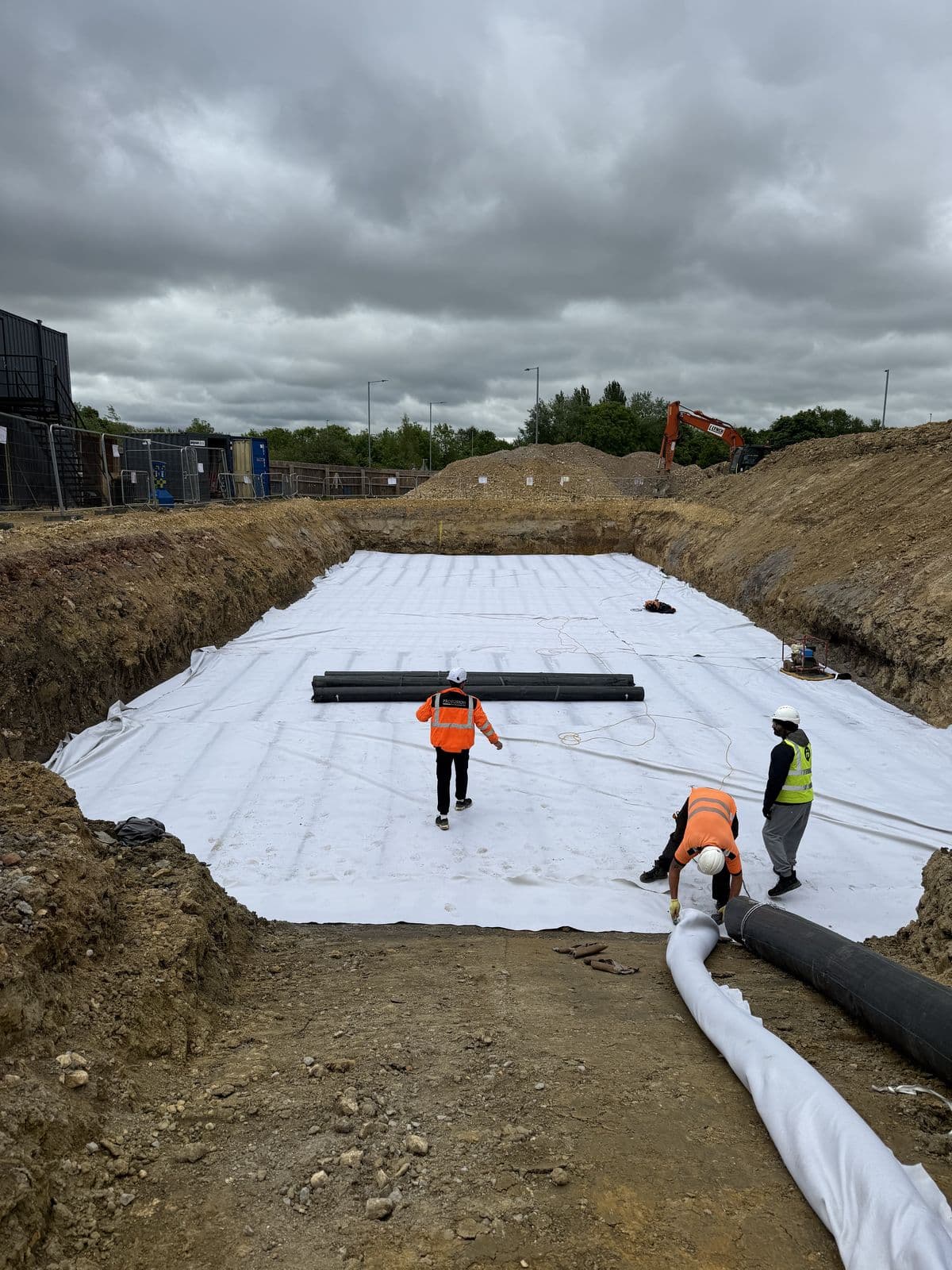
Boulder clay hides stones, and a GCL performs no better than whatever it's laid on. Your groundworker trims the formation smooth and firm and picks out anything sharp. Our crew walks it and only signs it off once it's fit, before any roll is cut open.

  • Rolls laid with broad overlaps, each lap bedded with bentonite paste or granules
  • Headwalls, outfalls and any pipes dressed in the same paste
  • A written note of each lap and detail kept as we work
  • QA sheets and the minimum soil depth passed to your team on completion

Cover goes on next

When our crew steps off, the confining soil goes on, placed by your contractor, and then the pond can fill. Bentonite needs that weight on top to seal; left bare and wet, it swells and washes away. We plan our days so the cover can follow straight on.

On larger National Forest wetlands or SuDS basins with a wildlife role, we can lay in stages so the cover never falls behind the liner, even if the weather breaks halfway through the job.

GCL Pond Lining Leicestershire

Frequently asked questions

Often it's exactly what they mean. Check with them, but a GCL under a soil cover gives the natural bed of a clay pond with a more dependable seal.

It suits gentler profiles because the cover soil has to stay put. For steep or exposed banks we'd usually suggest membrane.

Sometimes. Where a SuDS basin is meant to keep a permanent pool for wildlife and the water suits bentonite, a GCL under soil cover can work well. Where it takes silty road runoff and empties often, your engineer may prefer membrane.

That's your contractor's part, along with wetting it up, and it should happen within a day or so of our handover rather than weeks later.

Tell us about your project

Quote back within one working day