Lining
HDPE, LLDPE, EPDM and GCL Bentomat: A Contractor's Guide to Choosing the Right Pond Liner
Specify the wrong pond liner and you find out the expensive way — on site, mid-install, or worse, after the water goes in. HDPE, LLDPE, EPDM and GCL are not interchangeable: each is the right answer for a different site.
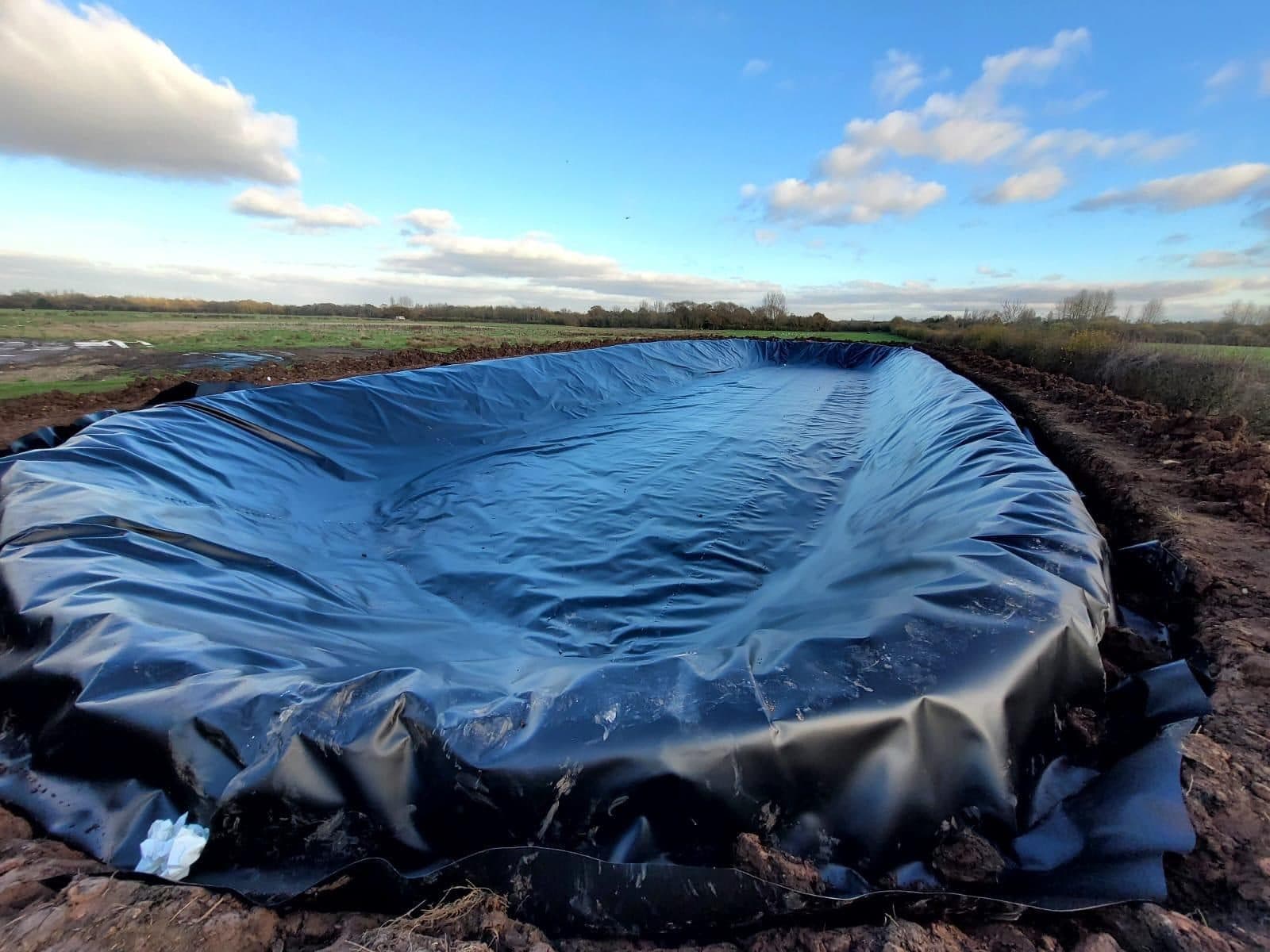
Specify the wrong pond liner and you find out the expensive way — on site, mid-install, or worse, after the water goes in. The four materials a UK groundwork contractor meets most often — HDPE, LLDPE, EPDM and GCL (often by the brand name Bentomat) — are not interchangeable. Each is the right answer for a different combination of site conditions, scale, chemistry and budget.
This guide is the plain-English version: what each material is, what it is good at, where it struggles, and how to choose between them without the sales gloss.
HDPE — the heavy-duty workhorse
High-Density Polyethylene is the default for large, demanding containment. It is tough, highly resistant to chemicals and UV, and has the long service life that engineered schemes are specified around. It is the material you reach for on attenuation tanks, lagoons, landfill and industrial containment.
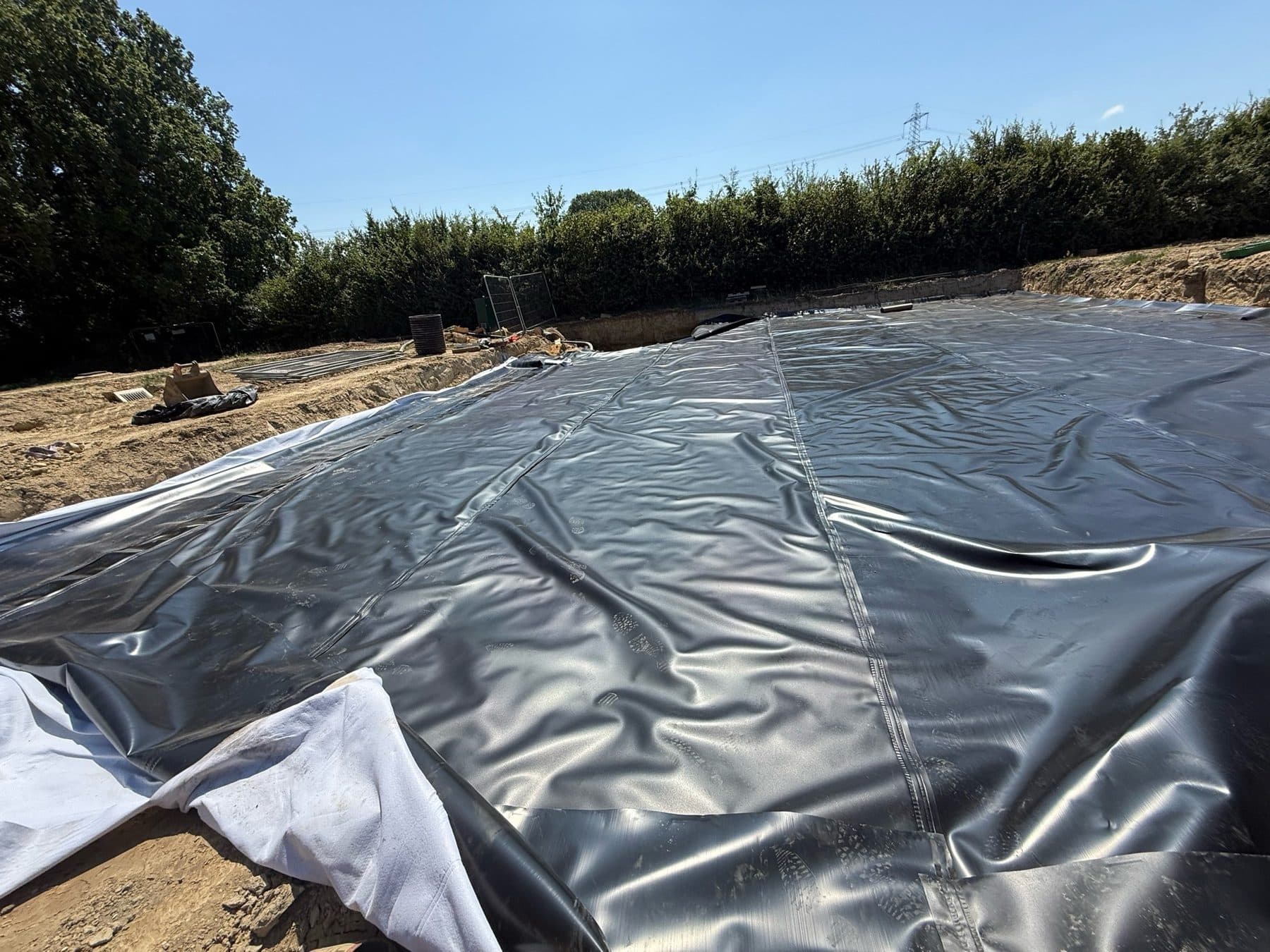
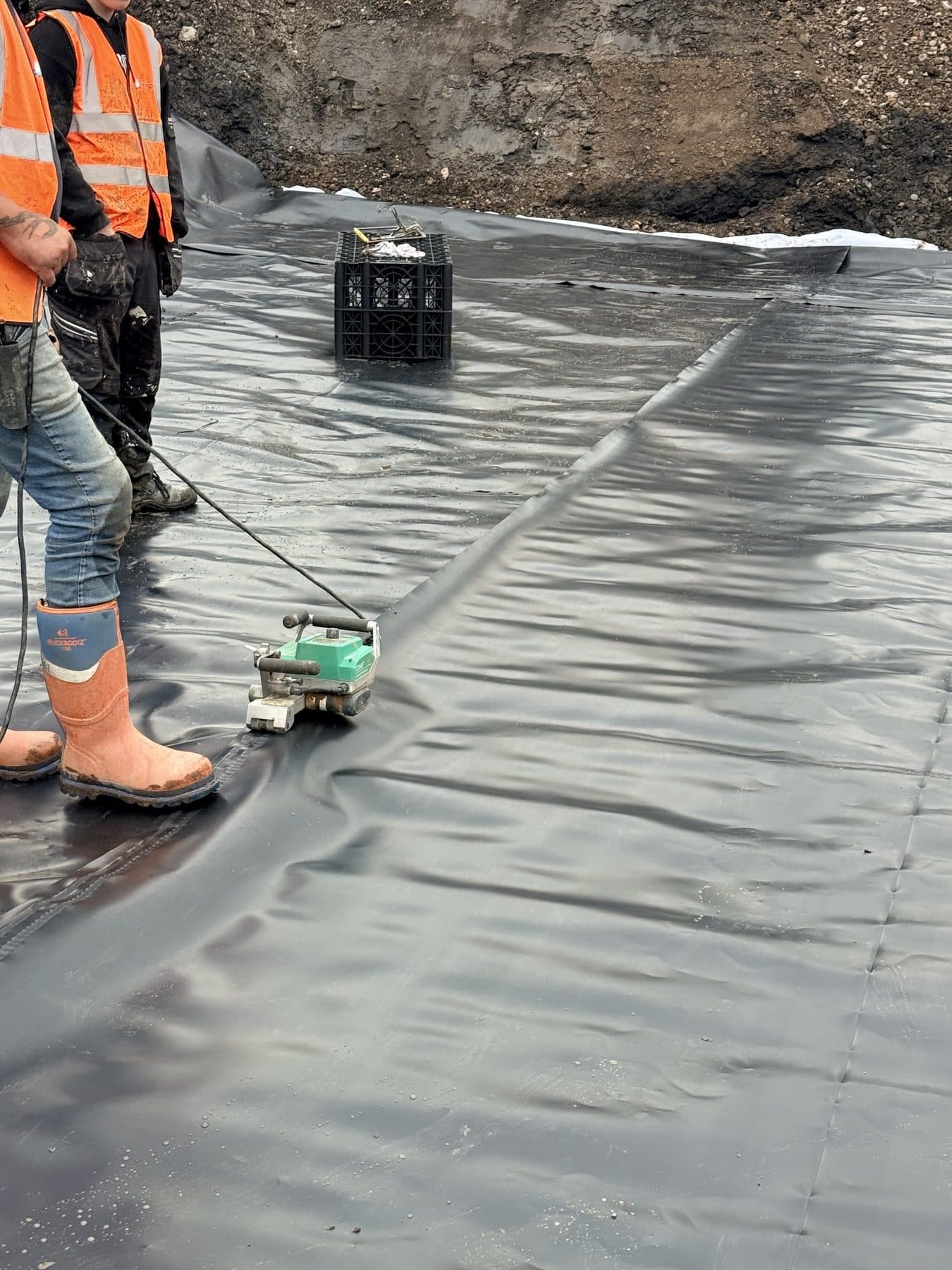
The trade-off is stiffness. HDPE is rigid and less forgiving to handle, so it needs skilled installation and is less happy conforming to highly irregular or detailed subgrades. It is joined by thermal welding — typically dual-track hot wedge welding, which means seams can be air-channel tested for proof of integrity.
Best for: attenuation tanks and basins, lagoons, large reservoirs, industrial and contaminated-site containment, and anywhere chemical resistance and longevity are the priority.
LLDPE — flexibility where the ground moves
Linear Low-Density Polyethylene is HDPE's more flexible relative. It is made for sites where the liner has to conform to irregular shapes, accommodate differential settlement, or wrap around detailing that would fight a stiffer sheet. That flexibility makes it easier to install around penetrations and complex geometry.
You give up a little chemical resistance and outright toughness compared with HDPE, but for many ponds and basins — especially on ground likely to settle unevenly — that flexibility is worth more than maximum rigidity. Like HDPE, it is a thermoplastic, so it is thermally welded and its seams can be tested the same way.
Best for: ponds and basins on settling or irregular ground, sites with lots of detailing, and applications that need conformance more than maximum chemical resistance.
EPDM — the flexible rubber option
EPDM is a synthetic rubber (ethylene propylene diene monomer). It is extremely flexible, UV-stable and long-lasting, and it can be supplied in very large prefabricated panels — which means few or no site seams on smaller jobs and a fast, straightforward installation.
Because it is a cured rubber, EPDM cannot be thermally welded. Seams are made with splice tape or adhesive, which is quick but relies on clean, dry surfaces and cannot be air-channel tested the way a weld can. That makes EPDM a strong choice for ornamental and lower-risk ponds, and a less defensible one for high-risk engineered containment where testable seams matter.
Best for: ornamental and garden ponds, water features, and smaller or lower-risk installations where flexibility and large single panels are the main advantage.
GCL Bentomat — the self-sealing clay liner
A Geosynthetic Clay Liner (GCL) is a different animal entirely. It is a layer of sodium bentonite clay sandwiched between two geotextiles, usually needle-punched together for strength. Bentomat is one of the best-known GCL brands, and the name is often used generically on site.
Its party trick is self-sealing. When the bentonite hydrates it swells dramatically to form a very low-permeability barrier — and if the liner is punctured, the clay swells over the damage and self-heals small defects. It installs fast: you unroll it and overlap the joints rather than welding, and one truckload covers a far larger area than the equivalent volume of compacted clay.
GCLs need confining pressure and hydration to work, and are frequently used as a base barrier underneath a geomembrane, or as a secondary containment layer, rather than as an exposed surface liner. They suit large-area sealing where a self-healing clay barrier is an advantage — slurry lagoons, landfill, agricultural and industrial containment.
Best for: large-area base sealing, secondary containment, slurry lagoons and agricultural sites, and as a self-healing barrier layer beneath a geomembrane.
Pond liner materials compared at a glance
| Material | Flexibility | Jointing | Testable seams | Typical use |
|---|---|---|---|---|
| HDPE | Low (stiff) | Thermal weld | Yes (air channel) | Attenuation, lagoons, industrial |
| LLDPE | High | Thermal weld | Yes (air channel) | Ponds on settling/irregular ground |
| EPDM | Very high | Tape / adhesive | No | Ornamental ponds, water features |
| GCL (Bentomat) | Conforms, self-seals | Overlap joints | n/a (clay barrier) | Lagoons, base sealing, agriculture |
How to choose: the questions that actually decide it
Material choice usually comes down to a handful of practical factors. Run the site through these before you specify:
- Risk and consequence of a leak. High-consequence containment (attenuation, industrial, contaminated sites) points to welded, testable HDPE or LLDPE. Low-risk ornamental ponds open the door to EPDM.
- Ground conditions. Ground likely to settle unevenly favours flexible LLDPE or EPDM over stiff HDPE; large-area sealing on variable ground may suit a GCL.
- Chemistry of what you are containing. Aggressive or contaminated liquids push you toward HDPE for its chemical resistance.
- Scale and detailing. Big, simple areas suit HDPE or GCL; complex geometry and lots of penetrations favour the flexibility of LLDPE or EPDM.
- Whether seams must be proven. If the specification or the client needs documented seam integrity, you need a thermally welded liner — HDPE or LLDPE — not a taped one.
- Budget and programme. EPDM and GCL can be quick to install; HDPE/LLDPE need skilled welding but deliver testable, long-life containment.
It is not always one liner
On bigger or higher-risk schemes the answer is sometimes a combination — for example a GCL as a self-healing base barrier with a welded geomembrane over the top, giving you both a clay backstop and a testable primary liner. The right specification follows the site, not a default preference.
Supply and install — with the right liner for the job
Aquatech Civils supplies and installs all four — HDPE, LLDPE, EPDM and GCL Bentomat — which means the recommendation you get is driven by your site, not by whatever happens to be in stock. For thermoplastic systems we install with hot wedge welding, with a recorded test weld and QA documentation at handover.
Not sure which liner your project needs? Send Aquatech the site details and we will help you specify, supply and install the right system first time.
Got a site that needs one of these?
Tell us the details and we'll come back with a quote within one working day.