SuDS
SuDS National Standards 2025: What Every Groundwork Contractor Needs to Know
June 2025 changed the rulebook for drainage on UK development sites. What the new national SuDS standards actually require, whether SuDS are now mandatory, and where Wales differs.
If you build drainage on UK development sites, June 2025 changed the rulebook you work to. DEFRA published a new set of National Standards for Sustainable Drainage Systems (SuDS) on 19 June 2025 — the first major refresh in a decade, replacing the 2015 technical standards that most contractors and engineers had been designing to for years.
The headlines have caused a fair bit of confusion on site. Are SuDS now mandatory? Do you need approval from a new body before you dig? What actually has to change in the way you design and install attenuation, soakaways and pond lining? This guide cuts through it for groundwork contractors and civil engineers working in England, and flags exactly where Wales differs.
What actually changed in June 2025
The 2015 standards were narrow. They were largely about hydraulics — peak flow rates, storage volumes and limiting discharge to reduce flood risk. The 2025 standards keep all of that and go much further, treating drainage as multifunctional infrastructure rather than a buried pipe network. Water quality, biodiversity, amenity and whole-life maintenance are now formal requirements, not nice-to-haves.
In practice that means the drainage strategy on a major development now has to demonstrate more, earlier, and in more detail. For contractors, the knock-on effect is that what you install on site — the treatment train, the destination of the runoff, the way the system is built and handed over for maintenance — is being specified more tightly than before.
Who this applies to: the standards apply to major developments in England — broadly 10 or more dwellings, residential sites of 0.5 hectares or more, or non-residential sites of 1 hectare or more. Smaller sites still meet sustainable drainage expectations through the planning system, but the seven standards are written around major schemes.
Are SuDS mandatory now? The Schedule 3 question
This is where most of the confusion sits, so it is worth being precise. In England, the 2025 National Standards are non-statutory. They are technical guidance, not a binding approval regime. There is still no SuDS Approving Body (SAB) in England, and you do not need separate SAB sign-off before construction the way you would in Wales.
Schedule 3 of the Flood and Water Management Act 2010 is the legislation that would make SuDS mandatory in England and introduce that SAB approval step. Despite being promised for 2024 and then hoped for in April 2025, it remains unenacted. An amendment to commence Schedule 3 was added to the Planning and Infrastructure Bill in 2025 and then withdrawn. The Government has signalled it prefers to strengthen the planning-led approach rather than switch Schedule 3 on, with a final decision still pending.
So compliance in England is enforced through planning conditions and the National Planning Policy Framework, not a binding consent regime. The practical effect is the same on most major sites: the drainage strategy has to meet the standards to get through planning, and the conditions follow the works onto site.
Wales is different. Schedule 3 has been in force in Wales since 7 January 2019. There, SuDS genuinely are mandatory, an SAB does exist, and approval is required before construction for developments with a construction area of 100m² or more, or more than one dwelling. If you work either side of the border, treat the two regimes separately.
The seven national standards, explained for site teams
The 2025 framework is built around seven standards. Standard 1 is the hierarchy standard; standards 2 to 7 are the fixed standards that set minimum design criteria. Here is what each one means in plain terms.
Standard 1 — Runoff destination (the hierarchy)
Runoff has to follow a strict order of preference, and you need evidence to justify dropping down a tier. The hierarchy runs: collect for non-potable reuse (rainwater harvesting) first; then infiltration into the ground; then discharge to a surface water body; then to a surface water sewer; and only as a last resort to a combined sewer. For installers this pushes more work toward infiltration features — soakaways, infiltration basins, permeable systems — and toward storage that holds water back rather than piping it straight off site.
Standard 2 — Interception of everyday rainfall
The first 5mm of most rainfall events should be managed on site through source control, with seasonal targets of around 80% in summer and 50% in winter. This is about keeping the small, frequent rain on site rather than sending it downstream, which favours green roofs, permeable paving, swales and other source-control features close to where rain lands.
Standard 3 — Peak flow and extreme rainfall
Systems must control flows across the range from frequent (1-in-1 year) up to extreme (1-in-100 year) events, restrict discharge toward greenfield runoff rates, and account for urban creep (commonly a 10% allowance) and climate change. In practice this is what drives the sizing of your attenuation storage — tanks, crates and basins — and the flow control device on the outfall.
Standard 4 — Water quality
A formal pollution risk assessment is now expected, with the treatment train tailored to the pollution risk of the land use. Dirtier catchments (car parks, yards, roads) need more treatment stages before discharge. This is where forebays, filter strips, swales and proprietary treatment devices earn their place in the design.
Standard 5 — Amenity
SuDS should be multifunctional and add value at surface level — landscape, public space, health and placemaking benefits, not just hidden hydraulics. For groundwork teams this means more above-ground features integrated with the wider landscape, and closer coordination with the landscaping package.
Standard 6 — Biodiversity
Drainage has to contribute to habitat creation and align with Biodiversity Net Gain (BNG) and Local Nature Recovery Strategies. Wet features, planted basins and naturalised ponds are increasingly part of the drainage scheme rather than a separate ecology item.
Standard 7 — Design for construction, operation and maintenance
This is the whole-life standard. Schemes need a clear maintenance plan, buildable details, safe access for inspection, and named responsibility for adoption and upkeep. For contractors this raises the bar on as-built quality, handover information and evidence that the system was built the way it was specified.
The seven standards at a glance
| Standard | What it covers | What it drives on site |
|---|---|---|
| 1. Runoff destination | Discharge hierarchy, reuse and infiltration first | More soakaways, infiltration, on-site storage |
| 2. Everyday rainfall | First 5mm managed on site | Source control: permeable paving, swales, green roofs |
| 3. Peak / extreme flow | 1-in-1 to 1-in-100, greenfield rates, climate + urban creep | Attenuation tank and crate sizing, flow controls |
| 4. Water quality | Pollution risk assessment, treatment trains | Forebays, filters, treatment devices |
| 5. Amenity | Multifunctional, surface-level value | Above-ground features, landscape coordination |
| 6. Biodiversity | Habitat, BNG, nature recovery | Wet features, planted basins, naturalised ponds |
| 7. Construction & maintenance | Whole-life design, access, adoption | As-built quality, handover packs, buildable detailing |
What this means for your next groundwork package
Strip away the policy language and the 2025 standards point at a handful of practical shifts for the people actually installing the system:
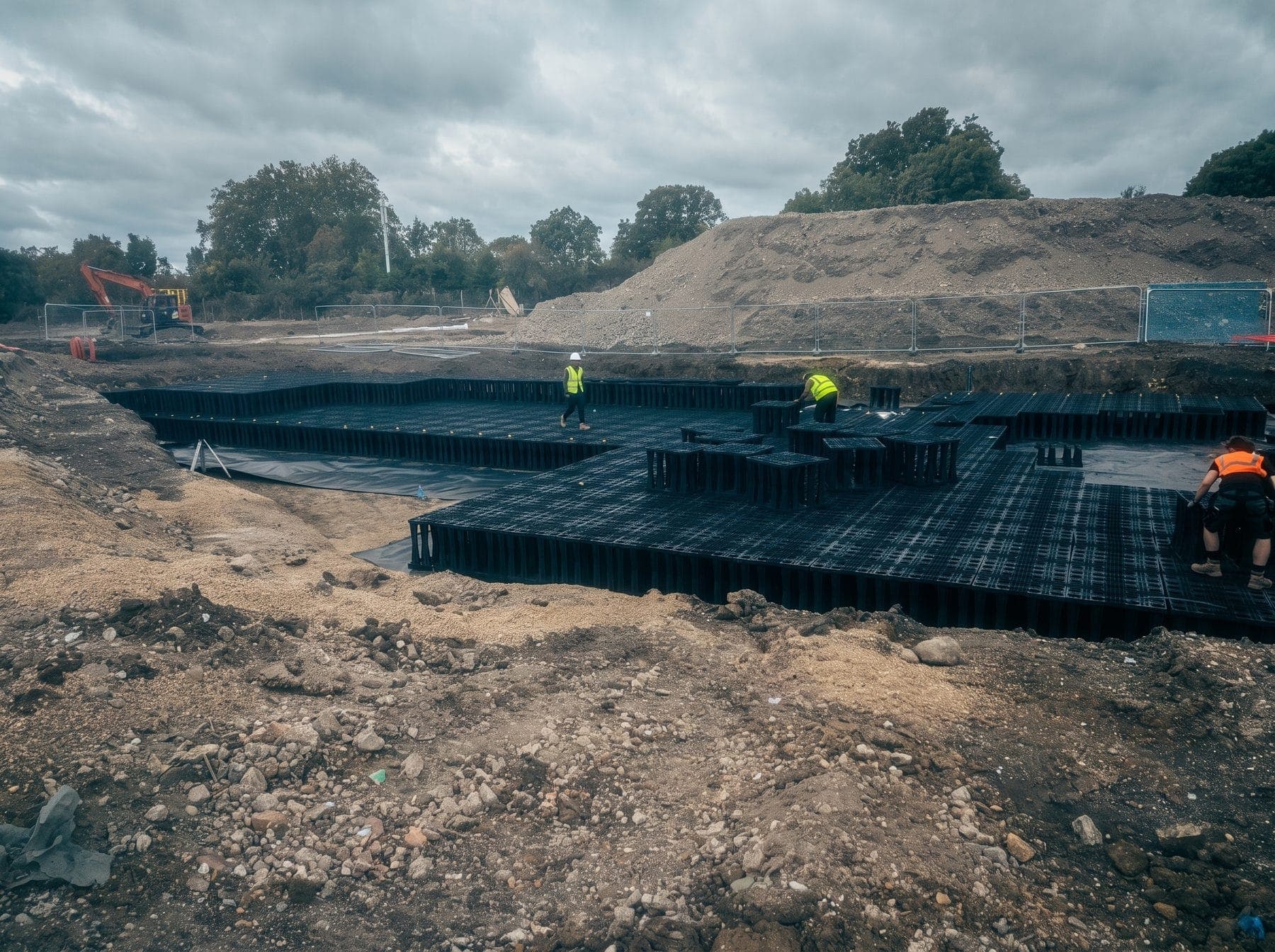
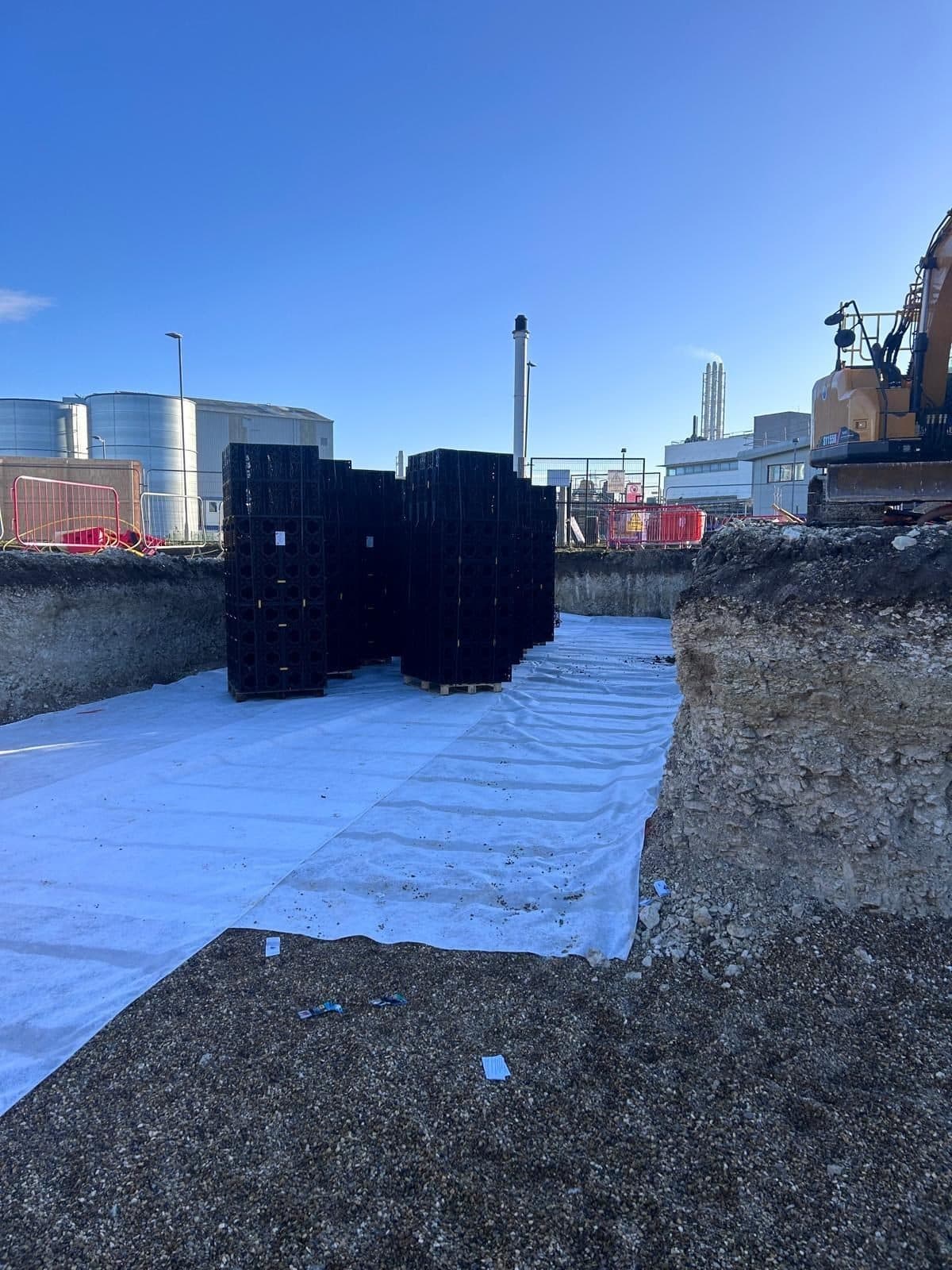
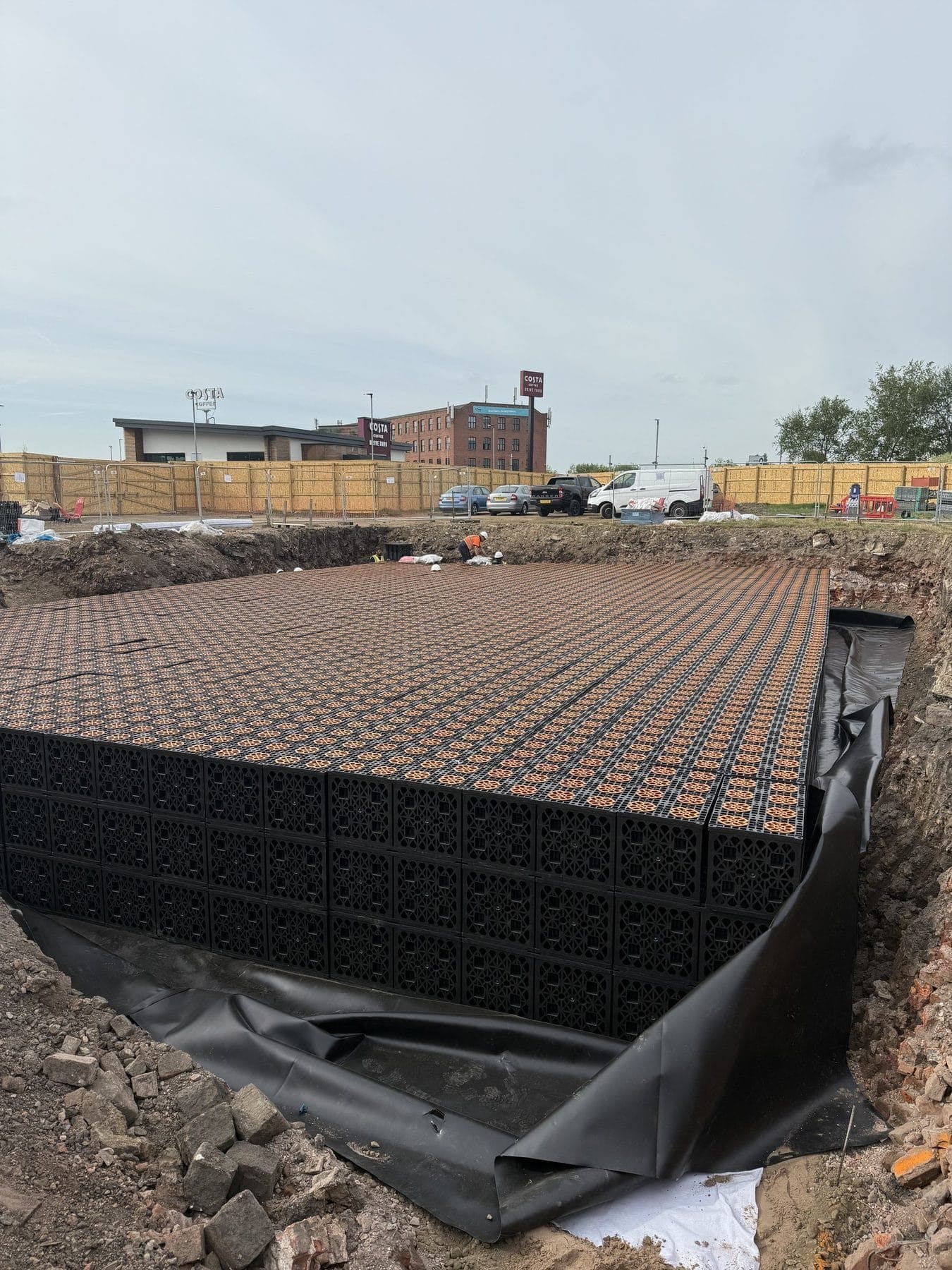
- Storage is doing more work. Tighter flow restriction and climate allowances mean attenuation volumes are rarely getting smaller. Getting the tank, crate or basin sized, built and connected correctly is central to compliance.
- Infiltration is back up the agenda. Because reuse and infiltration sit at the top of the hierarchy, soakaways and infiltration features are specified more often — and they have to be installed where ground conditions actually support them.
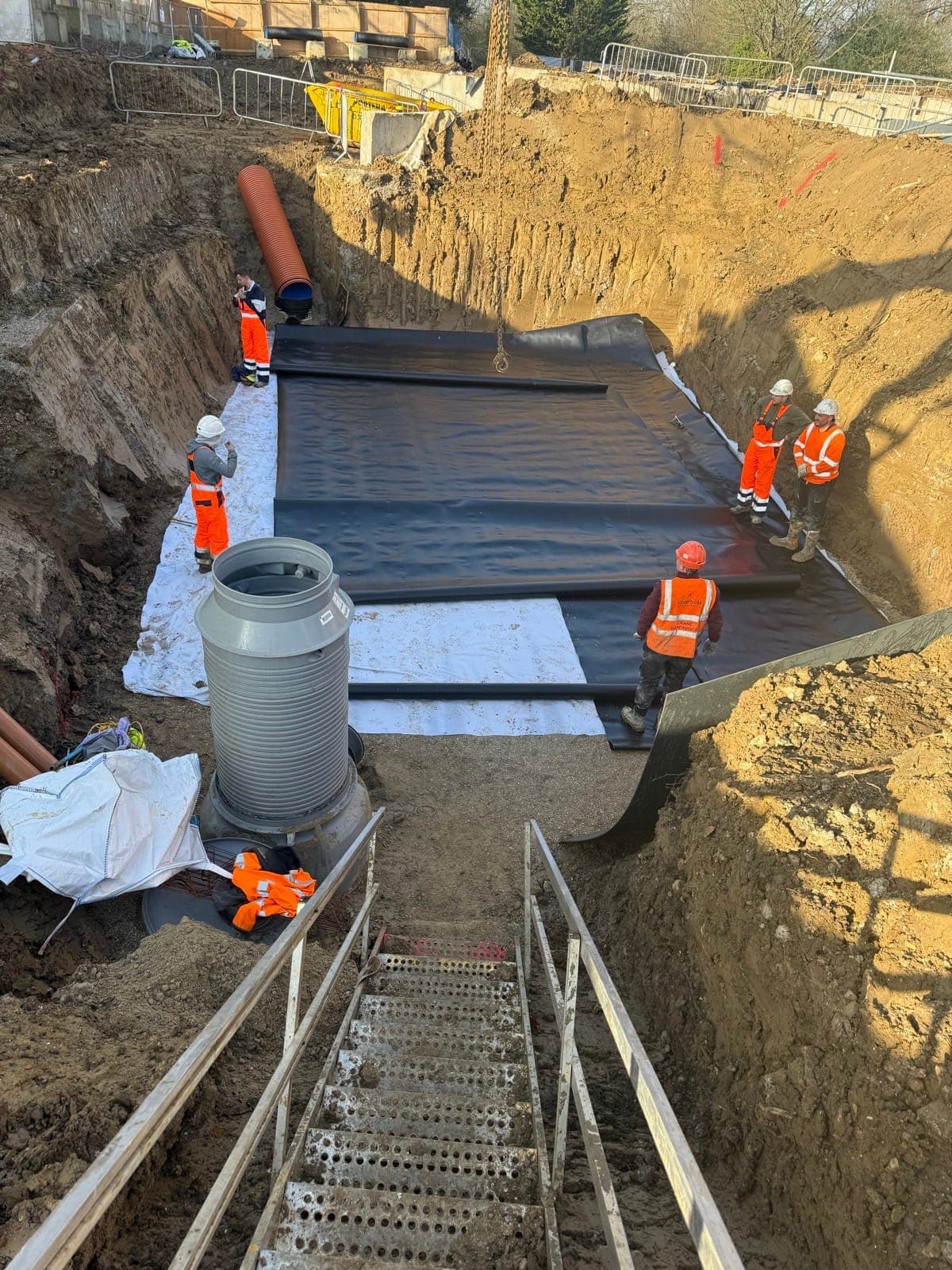
- Lining quality matters more. Attenuation ponds, basins and lagoons rely on the liner doing its job for decades. A poorly seamed or wrongly specified liner undermines the whole drainage strategy.
- Handover is part of the job. Standard 7 means as-built records, photos and evidence of correct installation are expected, not optional extras.
None of this is exotic. It is the same drainage work, specified more tightly and scrutinised more closely at planning and handover.
Getting SuDS installations right, first time
The 2025 standards reward schemes that are designed and built as a single, coherent system — the right storage, the right destination, treated to the right standard, and lined to last. That is exactly where a supply-and-install specialist earns its keep.
Aquatech Civils supplies and installs attenuation tank systems, soakaways, geomembrane and pond lining, and SuDS drainage across the UK — with welded, QA-tested liner installation and a single point of accountability from crate to outfall. If you have a SuDS package on a live or upcoming scheme, talk to us early, before the storage and lining details are locked in.
Need supply + install for an attenuation, soakaway or lining package? Get in touch with Aquatech Civils for a no-obligation conversation about your site.
Got a site that needs one of these?
Tell us the details and we'll come back with a quote within one working day.